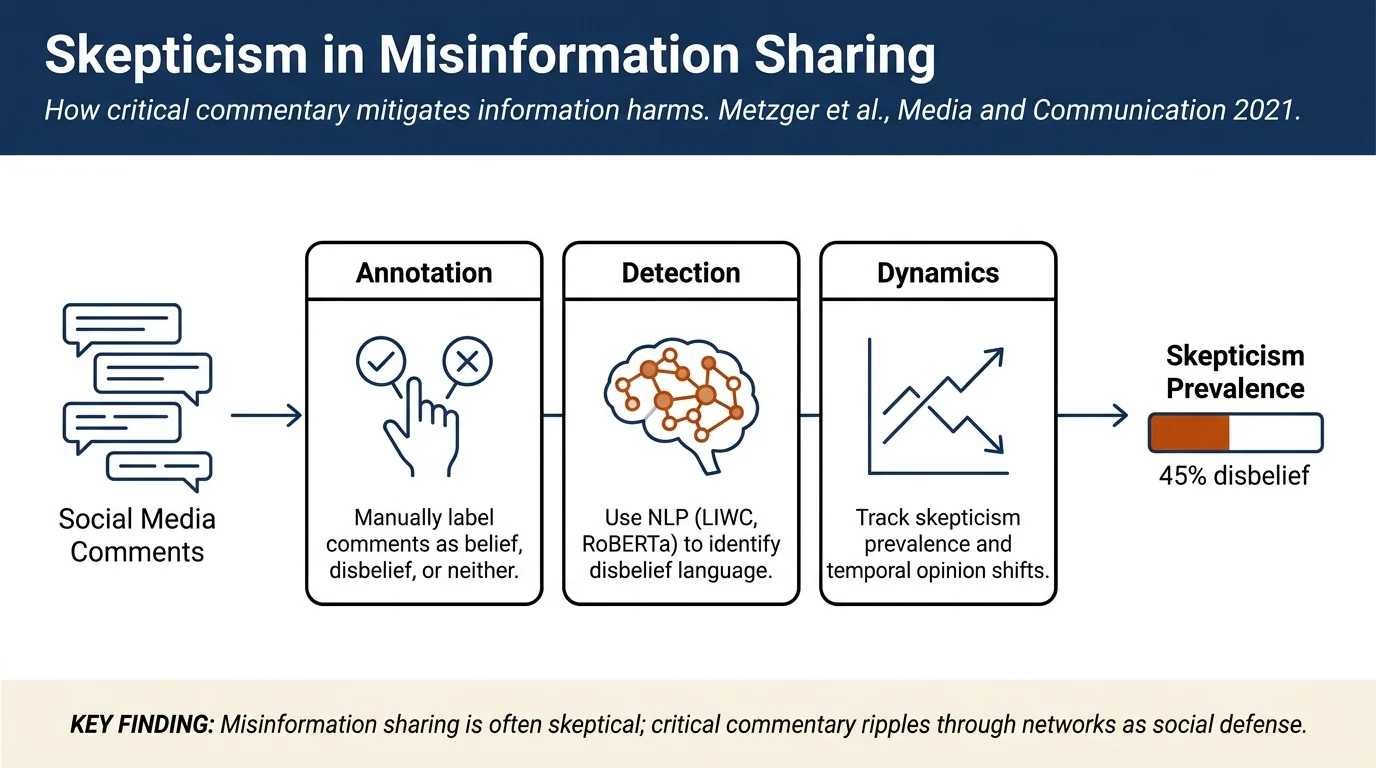
Understanding why people share misinformation is central to modeling its spread and designing interventions. Research reveals a diverse set of motivations that extend far beyond simple belief: social signaling, entertainment, political debate, and even intentional debunking of falsehoods all drive sharing behavior.
Key distinctions
Intentional vs. unintentional: Most classic models assume people unknowingly share false claims they believe to be true (unintentional sharing). However, 8–17% of social media users admit to intentionally sharing news they suspected or knew to be false, motivated by sarcasm, testing others' credulity, political debate, or entertainment. This distinction is critical: a sharer's credibility signals (tone, framing, accompanying commentary) can tip recipients toward disbelief rather than belief.
Shared motivations across true and false news: People share both real and false news for identical reasons: social status (appearing well-informed), opinion leadership, emotional arousal, and relationship building. The same gratifications that drive viral true news also drive viral misinformation, complicating detection-by-motivation approaches.
Novel motivations unique to misinformation: Intentional sharing of known falsehoods introduces distinct motivations absent from true-news sharing:
- Sarcasm and ridicule: Using absurd false claims to mock political opponents or highlight their supposed credulity.
- Collective fact-checking: Sharing suspected misinformation to crowdsource its debunking and reduce uncertainty.
- Education/warning: Deliberately broadcasting false claims with critical framing to warn others and signal one's own skepticism.
- Debate and contention: Sharing provocative false claims to engage political dialogue, attract attention, or disrupt mainstream narratives.
Key papers
- Metzger et al. (2021) — Comprehensive taxonomy of misinformation-sharing motivations drawn from news-sharing and rumor literature; empirically validates that people express widespread disbelief in false claims via commentary; proposes social commentary as a corrective mechanism analogous to Brandeis' "more speech" remedy.
- Duffy, Tandoc & Ling (2019) — Examines both unintentional and intentional fake news sharing; identifies that unintentional sharing correlates with emotional impact and relevance (same as true news), while intentional sharing correlates with social media fatigue, fear of missing out, and desire for entertainment/debate.
- Talwar et al. (2019) — Empirical study linking personality traits and social media behaviors to intentional fake news sharing; finds that self-disclosure, online trust, fear of missing out, and social media fatigue predict intentional sharing; establishes that high social media users are more likely to share false content knowingly.
- Chadwick, Vaccari & O'Loughlin (2018) — Demonstrates that entertainment-seeking and debate-oriented sharers are significantly more likely to intentionally spread false news than those motivated by information or persuasion; frames this as "democratically dysfunctional" but notes some sharers see it as normative political engagement on social media.
Connections
- News sharing behavior on social media — the broader phenomenon of which misinformation sharing is a subset.
- Credibility assessment — how sharers' motivations (signaling disbelief vs. endorsement) influence recipients' evaluations of content.
- Rumor cascades — historical research on rumors and gossip illuminates misinformation motivations (uncertainty reduction, relationship building, entertainment).
- Political polarization — partisan motivations (supporting ingroup, attacking outgroup) drive much intentional misinformation sharing.