 Firoj Alam
 Shaden Shaar
 Giovanni Da San Martino
 Preslav Nakov
Contributions
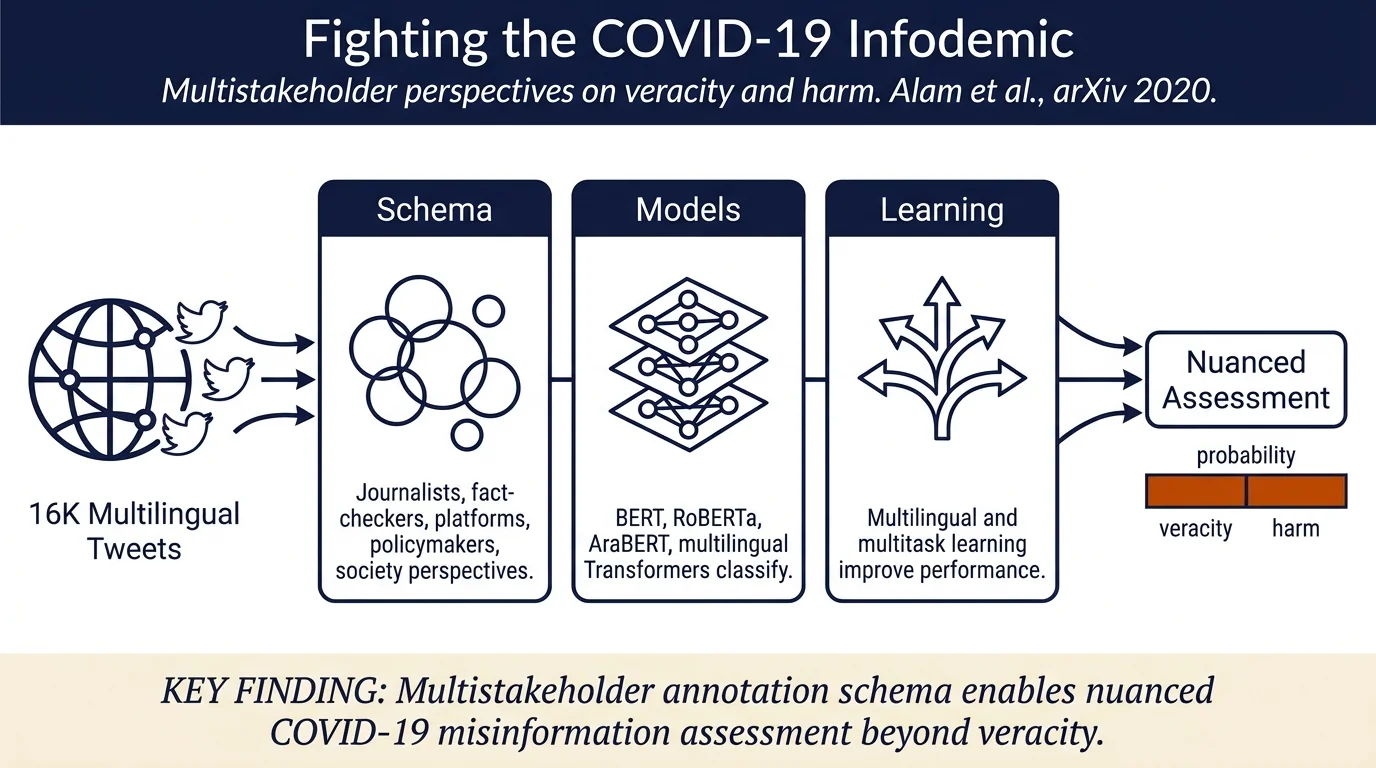
- Large multilingual dataset of 16K manually annotated COVID-19 tweets in English, Arabic, Bulgarian, and Dutch
- Annotation schema combining perspectives of five key stakeholder groups: journalists, fact-checkers, social media platforms, policy makers, and society
- Seven annotation questions: verifiable factual claim (Q1), false information (Q2), interest to general public (Q3), potential harm (Q4), need for fact-checking (Q5), need for government/policy action (Q7), harm to society (Q6)
- Evaluation of binary and multiclass classification using pretrained Transformer models (BERT, RoBERTa, AraBERT, BERTje, multilingual variants)
- Empirical validation of multitask and multilingual learning approaches
- Freely available dataset and code
Method
The annotation task involves determining whether COVID-19 tweets are factually verifiable, contain false information, are of interest to key stakeholders, and require policy or fact-checking intervention. The annotation schema uses a Likert-scale approach for most questions, allowing transformation into binary or multiclass labels. The authors collected tweets using COVID-19-related keywords in four languages, removed duplicates using similarity-based deduplication, and selected the most frequently liked/retweeted tweets for annotation.
Three annotators per tweet, with disagreements resolved through consolidation discussions. Fleiss Kappa measurements show moderate to substantial agreement across languages and question types. For modeling, the authors use pretrained contextual language models (BERT for English, AraBERT for Arabic, BERTje for Dutch, multilingual BERT) with standard fine-tuning on binary and multiclass variants. Multitask learning combines task-specific dense layers with shared Transformer embeddings.
Results
For binary classification on English, RoBERTa outperforms baselines on five of seven tasks, with weighted $F_1$ scores ranging from 48.7% (Q1: verifiable claim) to 90.9% (Q6: harmful to society). Multiclass settings are significantly harder, with scores ranging 36.5% (Q1) to 84.7% (Q6). Arabic and Bulgarian show generally high baseline performance on imbalanced classes (96%+ for Q2, Q3 dominant-class splits), making those tasks easier but less discriminative. Dutch models outperform baselines on most tasks, with FastText performing best on two of seven. Multilingual fine-tuning (mBERT) shows modest improvements over monolingual fine-tuning (~1-3% $F_1$), and multitask learning improves performance on Q2–Q5 (task-dependent questions) but degrades Q3 performance on imbalanced data.
Notes
Strength: multistakeholder annotation schema captures nuanced needs across journalists, platforms, and policy makers—not just binary true/false labels. This aligns with practical fact-checking workflows where veracity is only one dimension; harmfulness and policy relevance matter equally.
Weakness: class imbalance across all tasks makes multiclass evaluation difficult; some tasks (e.g., Q2 for Arabic) have 96% negative cases, making standard $F_1$ misleading. Authors acknowledge but don't apply techniques like cost-sensitive learning or threshold tuning.
Data availability is a substantial contribution; the dataset and code are released under the terms described in the paper, supporting reproducibility and downstream research.