Contributions
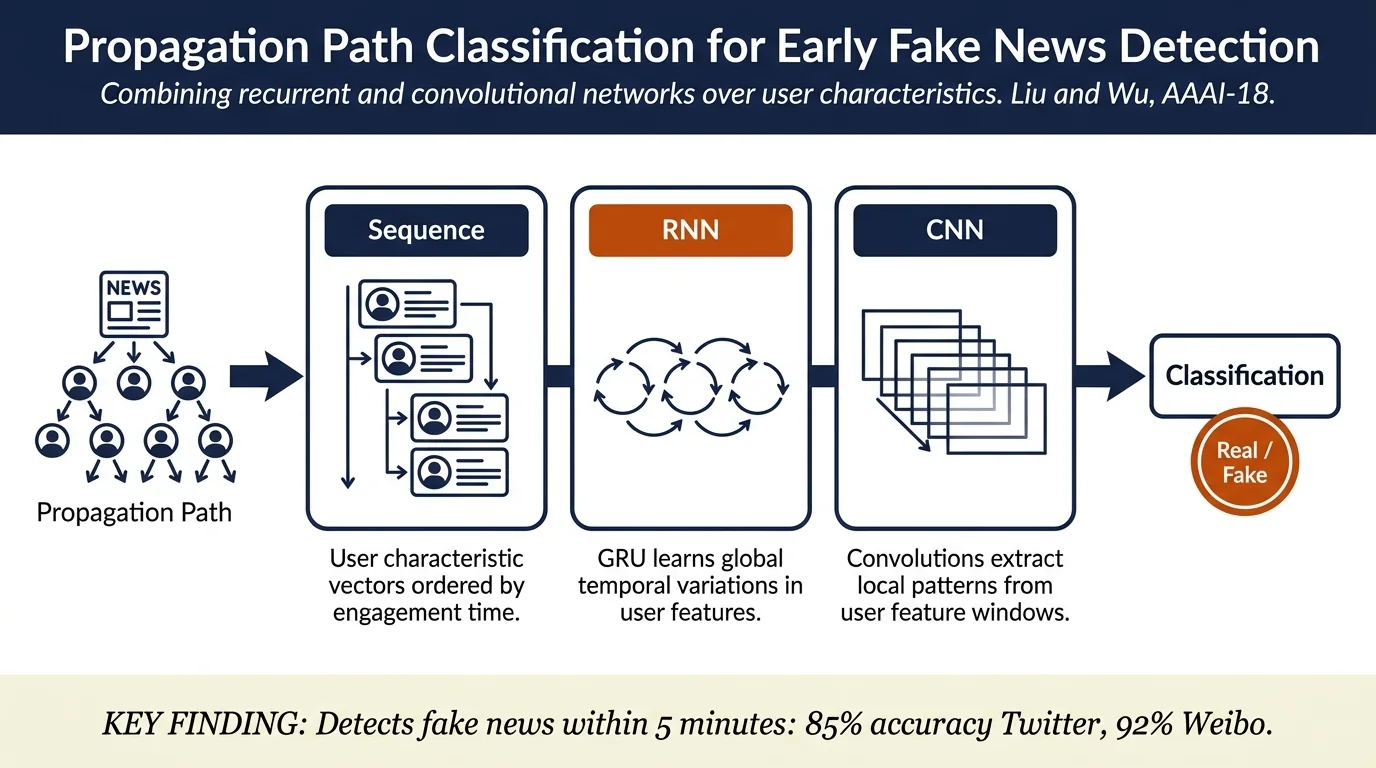
- First to model propagation paths as multivariate time series: Represents each news story's propagation path as a sequence of user characteristic vectors, rather than relying on text content or structural features.
- Combined RNN-CNN architecture: Uses gated recurrent units to capture temporal (global) variations in user characteristics and CNNs to capture local patterns, demonstrating that both are necessary for optimal performance.
- Focus on early detection efficiency: Addresses a critical limitation of prior work—that temporal-linguistic and structural features are often unavailable early in propagation. User characteristics are more stable and available from the start.
- Empirical validation on large-scale datasets: Evaluated on three real-world datasets (Weibo, Twitter15, Twitter16) with thousands of events and millions of posts.
Method
The model consists of four components:
Propagation Path Construction: Given a news story, the authors construct a propagation path P(aᵢ) by identifying all users who engaged in spreading it. Each user is represented by a feature vector with eight user characteristics: description length, username length, follower count, friend count, status count, registration age, verification status, and geo-enabled status. The variable-length sequence is transformed into a fixed-length sequence of length n through truncation (if longer) or random oversampling (if shorter).
RNN-Based Representation: A gated recurrent unit (GRU) processes the user feature sequence sequentially, learning hidden state representations that capture temporal dependencies. Mean pooling over all GRU outputs produces a single vector sR that encodes global variations.
CNN-Based Representation: Parallel 1-D convolutions with multiple filter heights extract local patterns from consecutive windows of user vectors, producing feature maps. Mean pooling yields vector sC encoding local variations.
Classification: Vectors sR and sC are concatenated and fed through a multi-layer feedforward neural network with softmax output to predict news veracity (binary or multi-class).
Results
On 24-hour detection deadline (standard evaluation):
- Twitter15: 84.2% accuracy
- Twitter16: 86.3% accuracy
- Weibo: 92.1% accuracy
The combined RNN+CNN model outperforms all baselines (DTC, SVM-RBF, SVM-TS, DTR, GRU, RFC, PTK). When evaluated for early detection (within 5 minutes), the model maintains high accuracy while baseline approaches degrade significantly. At 5 minutes:
- Twitter: ~85% accuracy after observing 40 retweets
- Weibo: ~92% accuracy after observing 30 retweets
Notes
Strengths: The insight that user characteristics are more stable and available early in propagation than linguistic or structural signals is compelling and well-validated empirically. The model achieves a meaningful speed-accuracy tradeoff: 5-minute detection with comparable or better accuracy than 24-hour baselines. The evaluation on two distinct platforms (Twitter and Weibo) demonstrates cross-platform robustness.
Limitations: User characteristics are relatively coarse features (counts, flags) that may not capture adversarial adaptations (e.g., accounts created specifically to spread disinformation). The fixed-length sequence transformation via random oversampling (rather than, e.g., learned pooling or attention) is crude. The 8 features are platform-specific and may not generalize beyond Twitter/Weibo. No analysis of which user characteristics are most predictive or how they correlate with spread patterns.
Open questions: How does the model degrade under adversarial account creation? Could learned pooling or attention mechanisms improve over random oversampling? How do results scale to other platforms and languages? Do user characteristics alone suffice for multimodal news (image, video)?