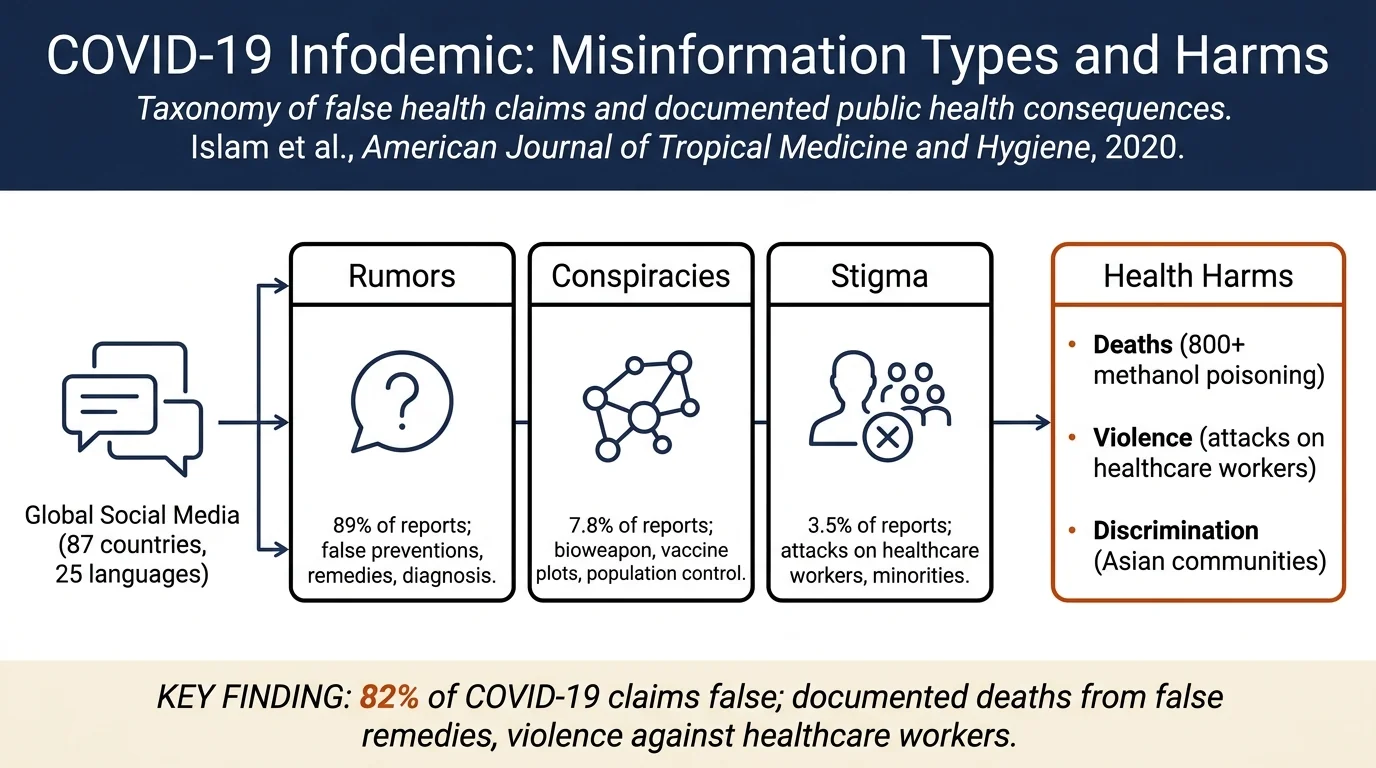
Stigma in the context of misinformation and public health refers to the socially constructed process through which individuals or groups are labeled, devalued, and subjected to discrimination based on perceived association with disease, exposure, travel history, ethnic descent, or roles during crises. During health emergencies and information crises, stigma becomes amplified through social media and can fuel violence, healthcare avoidance, delayed diagnosis, and community transmission of disease.
Key distinction
Stigma differs from general discrimination: it involves a marked person or group being labeled as "deviant," losing status in social hierarchies, and experiencing stereotype-based prejudice and discrimination as a result. In pandemic contexts, stigma targets healthcare workers, patients, people of particular ethnic origins associated (rightly or wrongly) with disease origin, quarantined individuals, and those who publicly acknowledge infection or vulnerability.
Manifestations in misinformation contexts
- Ethnic/national origin targeting: During COVID-19, individuals of Asian origin faced widespread stigma and physical violence, fueled by narratives blaming particular countries for disease origin
- Healthcare worker stigma: Repeated accounts of verbal abuse, eviction from housing, physical assault against healthcare workers during disease outbreaks
- Patient stigma: People with confirmed infection hiding symptoms, avoiding hospitals, delayed screening — paradoxically enabling transmission
- Self-stigma: Internalized shame and fear leading to worse health outcomes and, in documented cases, self-harm or suicide
Consequences documented in the literature
- Reduced health-seeking behavior and delayed diagnosis
- Healthcare-associated infections (when patients avoid hospitals or conceal symptoms)
- Violence and physical attacks
- Social avoidance and rejection
- Workplace discrimination and denial of services
- Erosion of trust in health institutions and public health messaging
Key papers
- Islam et al. (2020) — COVID-19–Related Infodemic and Its Impact on Public Health: Systematic global analysis documenting COVID-19 stigma across 87 countries; 3.5% of 2,311 misinformation reports; shows stigma against healthcare workers (bullying, eviction, discrimination), people of Asian origin (racial violence, media stigmatization), quarantined individuals, and Wuhan evacuees; documents cases of self-stigma-related suicide and reduction in healthcare-seeking behavior due to fear of discrimination
Related topics
- misinformation — stigma as a form of misinformation
- health-misinformation — stigma amplified during health crises
- polarization — mechanism underlying stigmatization
- conspiracy-theories — often target and stigmatize specific groups