Contributions
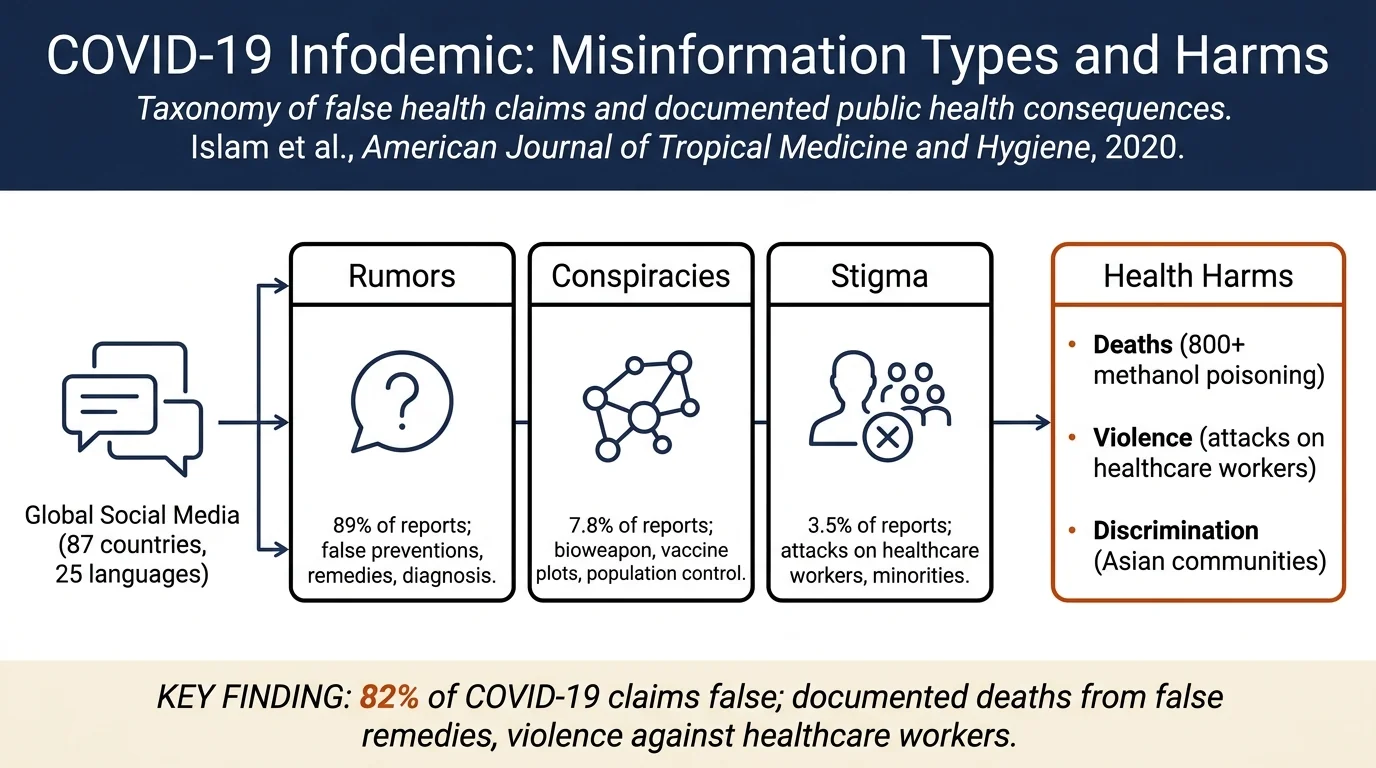
- Comprehensive global catalog of COVID-19 misinformation types: rumors (89%), conspiracy theories (7.8%), stigma (3.5%)
- Taxonomy of misinformation content: illness/transmission/mortality (24%), control measures (21%), treatment/cure (19%), disease origin (15%), violence (1%), miscellaneous (20%)
- Quantification of false claims: 82% of 2,276 rated claims were false, 9% correct, 8% misleading, 1% unproven
- Temporal tracking of three waves of infodemics (January–March 2020)
- Geographic analysis showing highest concentration in India, United States, China, Spain, Indonesia, Brazil
- Evidence linking misinformation to measurable harms: deaths, healthcare disruption, violence, discrimination
Method
The authors formed an interdisciplinary team of social scientists, medical doctors, and epidemiologists to systematically collect and categorize infodemic reports. They retrospectively collected COVID-19–related misinformation reports between December 31, 2019 and April 5, 2020 from multiple platforms: fact-checking agency websites, Facebook, Twitter, television network websites, and newspapers. Data were extracted into a password-protected Google Sheet, with exclusion of duplicates and untranslatable content. Double-checking and 5% spot verification ensured consistency. Team-driven consensus coding categorized content into three types (rumor, stigma, conspiracy theory) and five thematic areas (disease cause, illness/transmission, treatment, interventions, violence), with a sixth category (miscellaneous) added post-hoc. Rumor ratings (true, false, misleading, not proven) were extracted from fact-checking agencies. Descriptive analysis and stacked bar charts examined distribution by date and geography; a global map showed spatial distribution.
Results
2,311 misinformation reports identified across 25 languages from 87 countries. Distribution: 2,049 rumors (89%), 182 conspiracy theories (7.8%), 82 stigma reports (3.5%). Three temporal waves occurred January–April 2020. Of 2,276 reports with text ratings: 1,856 false (82%), 204 correct (9%), 176 misleading (8%), 31 not proven (1%). Geographic hotspots: India, United States, China, Spain, Indonesia, Brazil.
Rumor findings: Most prevalent category; peaked mid-March 2020. Content included false preventions (garlic, vitamins C/D, chlorine spray, sesame oil), false remedies (bleach, alcohol, cow urine, miracle mineral solutions), and false diagnosis (breath-holding test). Approximately 800 deaths reported from methanol poisoning in Iran following alcohol-as-cure rumors; 30 deaths in Turkey from similar misinformation; 12 poisonings (including children) in India from toxic Datura seeds following social media claims of COVID-19 immunity.
Conspiracy theories: Circulated globally. Key themes: COVID-19 as bioweapon engineered by international agencies (USA, Israel cited); vaccine conspiracy (vaccine already existed, pandemic to boost vaccine sales); population control schemes; economic warfare against China. Primarily circulated in China, Iran, Russia, United Kingdom, United States.
Stigma: Physical and verbal attacks on healthcare workers, people of Asian origin, quarantined individuals, Wuhan evacuees. High-profile figures referred to "Chinese virus" / "Wuhan virus." Media headlines stigmatized Chinese students. Documented case: Australian healthcare worker with Chinese heritage mocked for coronavirus risk. Reports of discrimination in apartment access, school exclusion. One case of self-stigma-related suicide (man in India). 26 episodes of stigma-related violence documented, including buses of evacuees pelted with stones in Ukraine. Fear of stigma led to symptom hiding, delayed healthcare-seeking, reduced screening participation—enabling community transmission.
Notes
Strengths: Large global sample with multi-language coverage; interdisciplinary team; systematic categorization; direct documentation of real-world harms (deaths, violence); temporal analysis capturing early pandemic trajectory. Fills a key gap in understanding COVID-19–specific misinformation landscape during critical early months.
Limitations: Restricted to public online platforms (excludes offline rumors, private messaging); relies on Google Translate for non-English content (potential accuracy loss); cannot measure actual belief prevalence or behavior adoption; classification subject to bias given rapid information evolution (myths reclassified as facts and vice versa). Sample concentrated in English-language sources despite multi-language claim.
Broader significance: Demonstrates concrete health consequences of infodemics beyond theoretical concern—documented deaths, hospitalization, healthcare-associated infections, violence, panic-buying disrupting essential supply chains. Positions systematic misinformation monitoring and early debunking as essential pandemic preparedness functions. Highlights role of fact-checking agencies and need for local-language, evidence-based messaging.