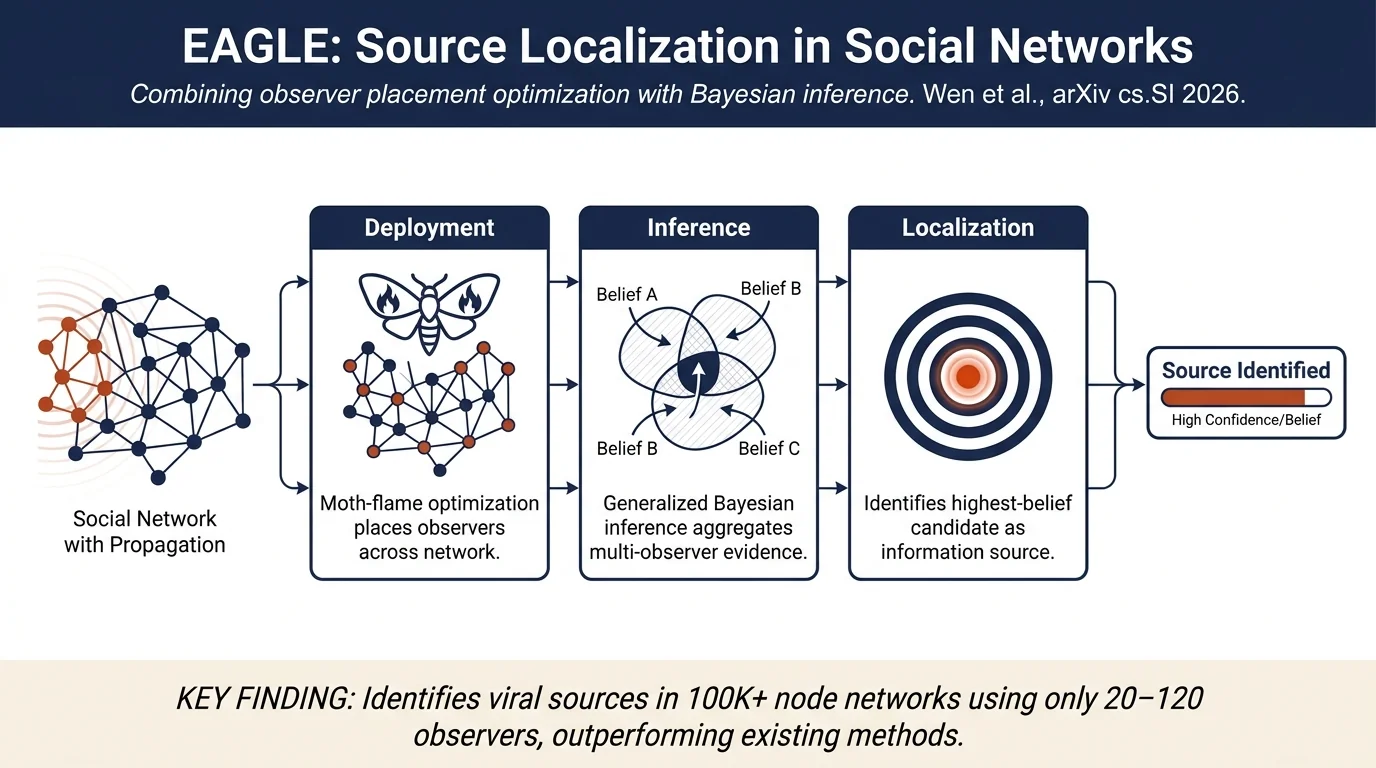
The problem of identifying the origin (source node) of information, rumors, or misinformation spreading through a network. Given partial observations of diffusion—limited information about which users have received a message and when—source localization aims to infer the source using network structure, temporal dynamics, and observer placement strategies.
Key concepts
Observer-based inference — Identifying sources from observations made by strategically placed monitors in the network. Observers record timing and direction of received information; the source is inferred by aggregating evidence across multiple observers and accounting for network paths.
Likelihood-based estimation — Source identification as a maximum-likelihood or Bayesian problem: given observed cascade data, which source node maximizes the likelihood of producing exactly those observations? Approaches differ in assumptions about propagation models, observer reliability, and computational tractability.
Structural credibility — Observer reliability varies by network position (high-degree nodes are more trustworthy; isolated nodes are noisier). Credibility weighting enables robust inference from heterogeneous observer networks.
Trade-offs in observer placement — Balancing coverage (fraction of network within observation range) against redundancy (multiple observers per candidate source for cross-validation). Optimization under resource constraints is NP-hard; metaheuristics like genetic algorithms and moth-flame optimization enable practical solutions.
Key papers
- EAGLE: Early Identification of Information Propagation Sources through Generalized Bayesian Inference in Large-scale Social Networks — moth-flame optimization and belief-function Bayesian inference for early source identification in large networks with sparse, noisy observations
Related topics
- Information propagation — broader study of how information spreads
- Network inference — inferring properties of networks and diffusion processes from observations
- Rumor detection on social media — identifying false rumors, related to source identification for intervention