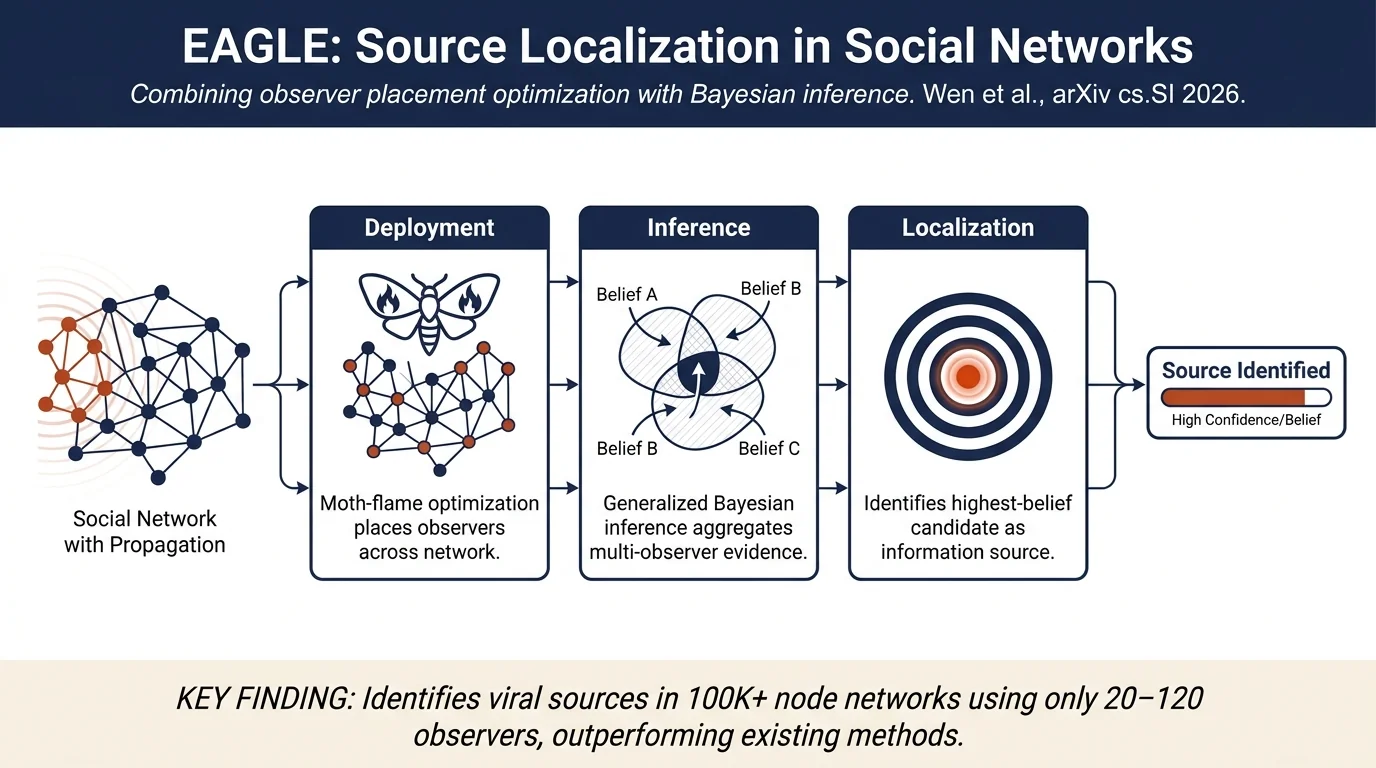
The problem of reconstructing or estimating properties of networks and their dynamics from limited or noisy observations. Network inference encompasses inferring network structure from correlation data, estimating diffusion parameters from cascade observations, identifying information sources from spread patterns, and learning network dynamics under uncertainty.
Key concepts
Incomplete observation — Real-world observations are sparse (not all nodes monitored), noisy (timing or direction errors), and delayed. Inference must account for unobserved spreading paths and missing data.
Uncertainty representation — Uncertainty arises from multiple sources: structural ambiguity (multiple network topologies fit the same observations), parameter uncertainty (unknown diffusion rates), and observation noise. Bayesian and belief-function frameworks explicitly model these.
Identifiability — When multiple parameters or network structures are consistent with observations, identifiability fails. Robustness requires methods that work reliably under non-identifiable conditions.
Scalability — Large networks (millions of nodes) require computationally efficient inference. Sampling-based, variational, and approximate Bayesian methods trade exactness for speed.
Key papers
- EAGLE: Early Identification of Information Propagation Sources through Generalized Bayesian Inference in Large-scale Social Networks — generalized Bayesian inference for source identification using belief functions and observer credibility weighting
Related topics
- Information propagation — dynamics being inferred
- Source localization — inferring source node from spreading patterns
- Network science — structural properties enabling inference