The study of psychological mechanisms by which people come to believe false claims and how misinformation adheres despite corrections or contrary evidence. This field integrates cognitive psychology (memory, attention, reasoning), social psychology (identity, group dynamics, conformity), and behavioral science to explain both why people are susceptible to misinformation and when and how they can be helped to disbelieve it.
The psychology of misinformation operates across two timescales: immediate processing (how people parse a single false claim on first exposure) and persistence (how false beliefs remain stable and resistant to correction over time). Both involve the interaction of cognitive mechanisms (fluency, heuristics, reasoning) and motivational factors (identity protection, group loyalty, desire for simple explanations of complex events).
Cognitive mechanisms of misinformation susceptibility
Cognitive fluency and illusory truth effect: Repeated exposure to a false claim increases its perceived truthfulness, independent of actual verification. People rely on how easy a statement is to process (fluency) rather than on explicit knowledge of truth. This effect is robust even when people possess correct information and know the claim has been disputed.
Information parsing and selective attention: People parse new information through existing beliefs and may selectively attend to details that confirm their prior worldviews (confirmation bias). When motivated reasoning is high—when the claim aligns with identity or group membership—this selectivity increases. However, attention is not always defensive; people may also overlook inaccuracy when they are cognitively taxed (lazy cognition).
Ambiguity and explanatory gaps: When people encounter events or policies they do not fully understand, they seek explanations. Misinformation often fills these gaps. For example, unexplained illness, economic disruption, or crime can be explained by conspiracy claims, which provide both a coherent narrative and an identifiable agent (reducing felt uncertainty). Corrections work best when they provide an alternative explanation that also resolves the ambiguity.
Motivational factors and identity protection
Motivated cognition and identity-protective thinking: People are motivated to defend their existing beliefs, especially those tied to social identity, political ideology, or religious commitments. When a claim threatens identity or group image, people resist it more strongly (identity-protective cognition). Conversely, claims that enhance group image are accepted more readily, even when evidence is weak. This motivation operates implicitly; people typically feel they are reasoning from evidence, not protecting identity.
Lazy cognition (inattentional processing): In many real-world settings, people do not engage in motivated reasoning; instead, they simply do not engage in careful reasoning at all. Social media posts are skimmed, headlines are read without articles, and accuracy goals are low-salience. In these conditions, accuracy can be less important than other factors (social acceptability, virality, alignment with group norms). This distinction matters for intervention: motivated bias requires interventions that make identity-congruent information less psychologically appealing; lazy cognition requires interventions that increase salience of accuracy itself.
Social and group-level factors
Social identity and group conformity: Beliefs are shaped by group membership and norms. People conform to what they perceive as group consensus, even when this contradicts personal knowledge. Social identities (partisan, religious, professional, national) predict belief in conspiracy theories and false claims better than education level or reasoning ability.
Echo chambers and information homogeneity: In online spaces, algorithms and user choice combine to reduce exposure to diverse viewpoints. While echo chambers exist and amplify political beliefs, the relationship between echo chamber exposure and false belief is not universal; many people in homogeneous information environments remain accurate in some beliefs while polarized in others. The psychological cost of leaving an echo chamber (social ostracism, identity threat) can itself sustain participation.
False consensus and social proof: People judge the truth of a claim partly by their perception of how many others believe it. This false consensus effect means that misinformation can become "stickier" when it appears widely shared (even if unverified). Social proof—the sense that others endorse a claim—increases belief, even when the sources are low-credibility.
Resistance to correction
Backfire effects and correction failures: Fact-checks do not always reduce belief in false claims and can occasionally amplify it (backfire effect). However, backfire is likely rarer than initially believed; meta-analyses show that fact-checks typically reduce false belief, though the effect can be small and varies by context. Backfire is most likely when corrections are framed in ways that threaten identity or when corrections come from a source the recipient distrusts.
Continued influence of misinformation: Even when explicitly corrected, false claims can continue to influence people's reasoning and decisions (continued influence effect). This occurs because memory for the claim persists even when memory for the correction is weak, and because corrections can inadvertently activate the false claim again.
Psychological cost of belief change: Adopting a correction can be psychologically costly if it requires admitting prior error, changing group alignment, or reassessing trusted sources. When corrections frame the previous belief as foolish or when they come from outgroup members, the psychological cost increases and resistance increases.
Key papers
- Efstratiou & De Cristofaro (2022) — Adherence to Misinformation on Social Media Through Socio-Cognitive and Group-Based Processes — Comprehensive review integrating cognitive dissonance theory with empirical findings on misinformation psychology, fact-checking, echo chambers, and interventions.
Related topics
- Belief formation — foundational mechanisms of how beliefs are acquired and updated
- Motivated reasoning — tendency to defend preferred conclusions against evidence
- Identity-protective cognition — political and social identity shaping factual beliefs
- Echo chambers — information homogeneity and group polarization
- Fact-checking and corrections — interventions to counter misinformation
- Political polarization — divergence of factual beliefs along ideological lines
Papers on this topic
 Psychology & interventions
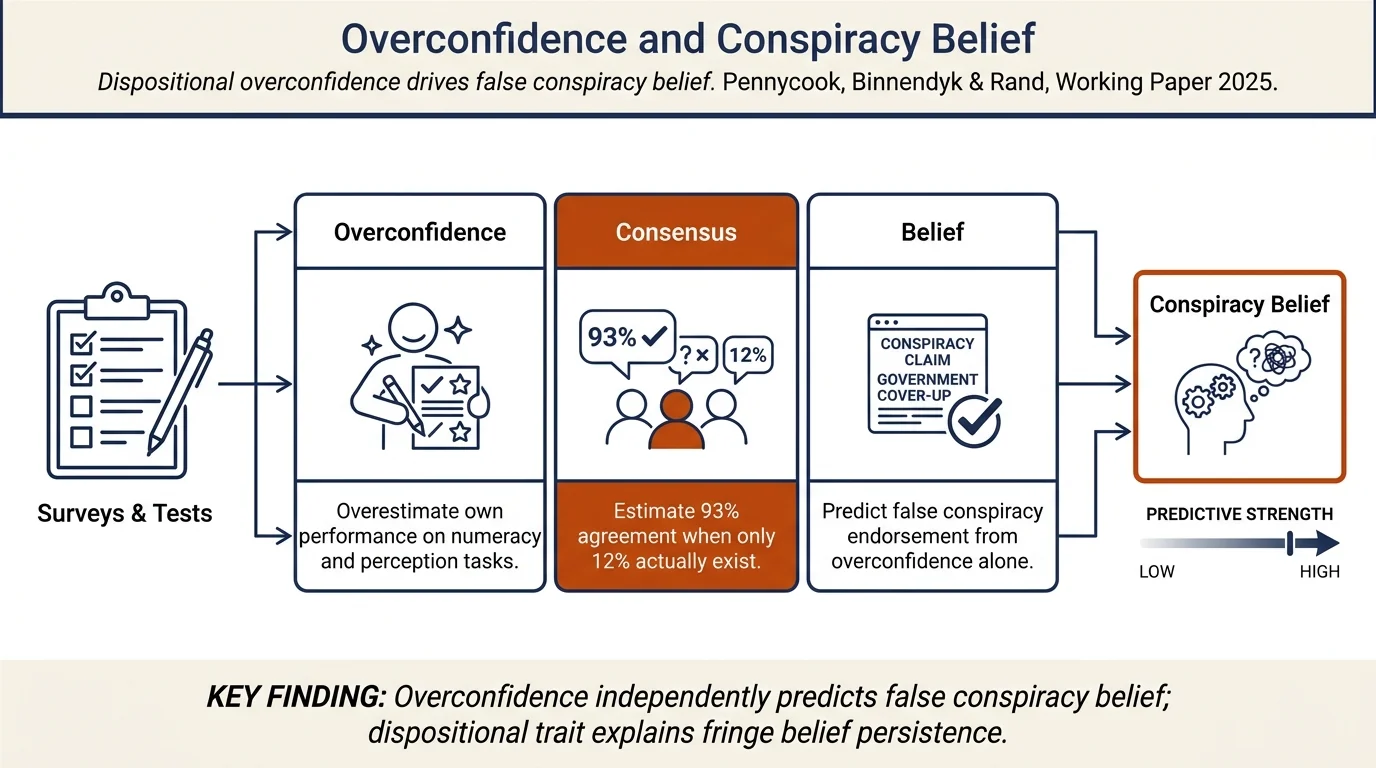
Overconfidently conspiratorial: Conspiracy believers are dispositionally overconfident and massively overestimate how much others agree with them
Psychology & interventionsPlatforms, policy & society
Thinking Clearly About Misinformation
Psychology & interventionsDetection methods
The Misinformation Susceptibility Test (MIST): A psychometrically validated measure of news veracity discernment
Detection methodsSpread & networks
Adherence to Misinformation on Social Media Through Socio-Cognitive and Group-Based Processes