Corrections and retractions are explicit statements designed to replace or refute false information. They are distinct from fact-checks (which are investigative outputs that may or may not lead to corrections) and from media literacy or inoculation approaches (which are preventive rather than corrective).
Corrections typically attempt to:
- Negate the false claim (e.g., "It is not true that vaccines cause autism")
- Provide an alternative explanation (e.g., "Vaccines undergo rigorous safety testing")
- Support the correction with evidence (e.g., cite clinical trial data)
The effectiveness of corrections depends on multiple factors: the strength of the original false belief, the audience's pre-existing attitudes, the trustworthiness of the correction source, the timing and format of the correction, and contextual factors such as cognitive load or time pressure.
Key challenges
- Continued influence effect: even corrected misinformation continues to influence reasoning and memory
- Backfire effects: in rare cases, corrections designed to dispel false beliefs paradoxically reinforce them
- Weak integration: corrections often fail to fully replace false beliefs; both old and new information coexist in memory
- Reachability: corrections reach far fewer people than the original false claims
Key papers
-
Carey et al. (2025) — Prebunking and credible source corrections increase election credibility: Evidence from the US and Brazil — Three experimental studies comparing retrospective corrections (from credible partisan sources like Republican leaders) with prospective prebunking (warning about false claims in advance) for countering voter fraud misinformation. Both increase election confidence and reduce fraud beliefs; credible source corrections less effective than prebunking, particularly in Brazil. Demonstrates persistence of correction effects across waves and identifies heterogeneous effectiveness among the most misinformed.
-
Pike et al. (2023) — Examining the replicability of backfire effects after standalone corrections — Three pre-registered experiments (N=1,156) testing whether corrections presented without prior misinformation exposure backfire. Finds no evidence of standalone correction backfiring immediately or after one-week delay; mixed evidence in open-ended responses when skepticism toward the correction source is high, but rating-scale measures show no backfire, suggesting measurement method is critical.
- Sanderson, Bowden, Swire-Thompson, Lewandowsky & Ecker (2022) — Listening to Misinformation while Driving: Cognitive Load and the Effectiveness of (Repeated) Corrections — Tests single vs. repeated corrections under cognitive load; finds repeated corrections more effective and minimal evidence of backfire effects even under cognitively constrained conditions
- Ecker, Lewandowsky, Swire & Chang (2011) — Correcting false information in memory: Manipulating the strength of misinformation encoding and its retraction — Foundational study showing strength of retraction affects continued influence; stronger retractions reduce but don't eliminate effects
- Ecker, Butler & Hamby (2020) — You don't have to tell a story! A registered report testing the effectiveness of narrative versus non-narrative misinformation corrections — Registered report finding both narrative and non-narrative corrections effective, with narrative format providing no additional benefit
Related topics
- Continued influence effect — the central phenomenon that corrections attempt to address
- Fact-checking and corrections — a broader ecosystem that includes correction dissemination
- Cognitive load — moderates correction effectiveness
- Psychology of belief formation and reasoning — explains why corrections often fail to fully change false beliefs
Papers on this topic
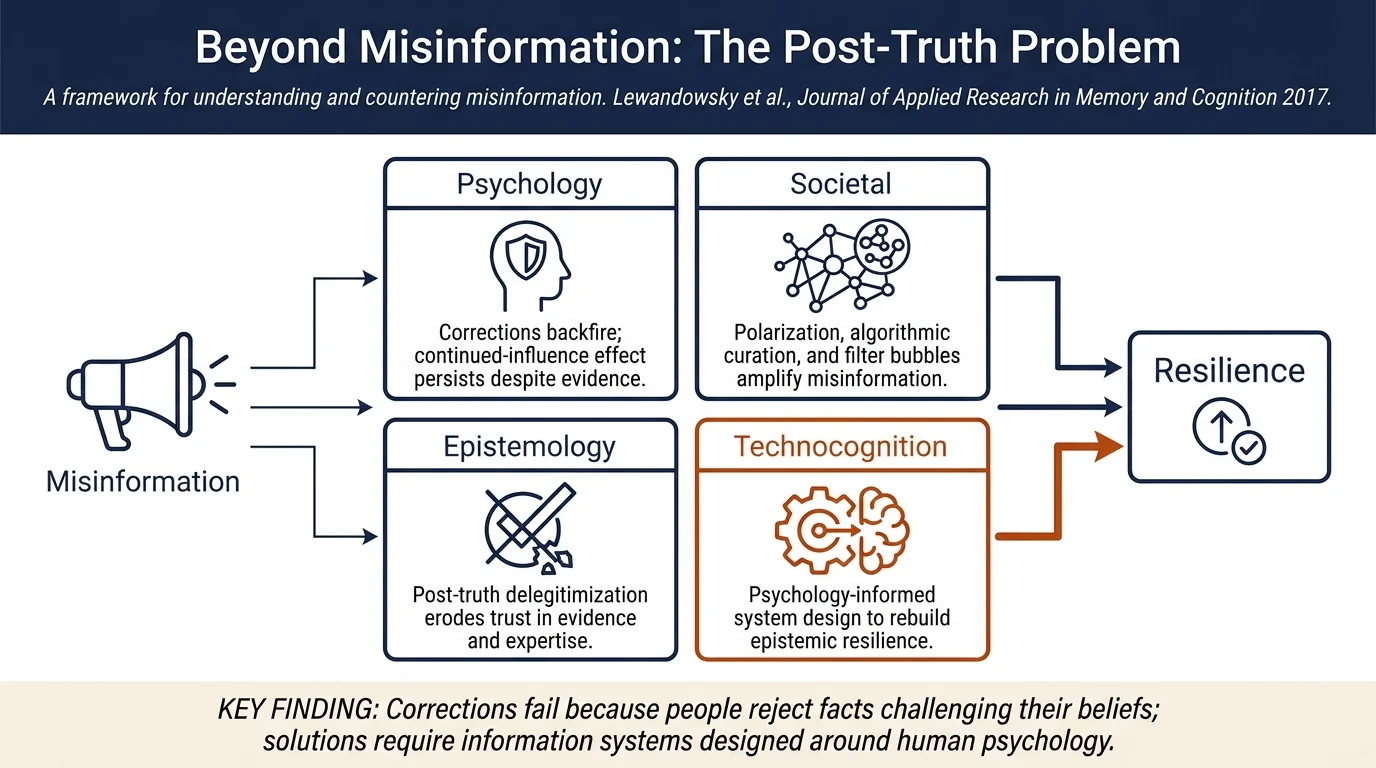 Detection methodsPsychology & interventions
Beyond Misinformation: Understanding and coping with the post-truth era
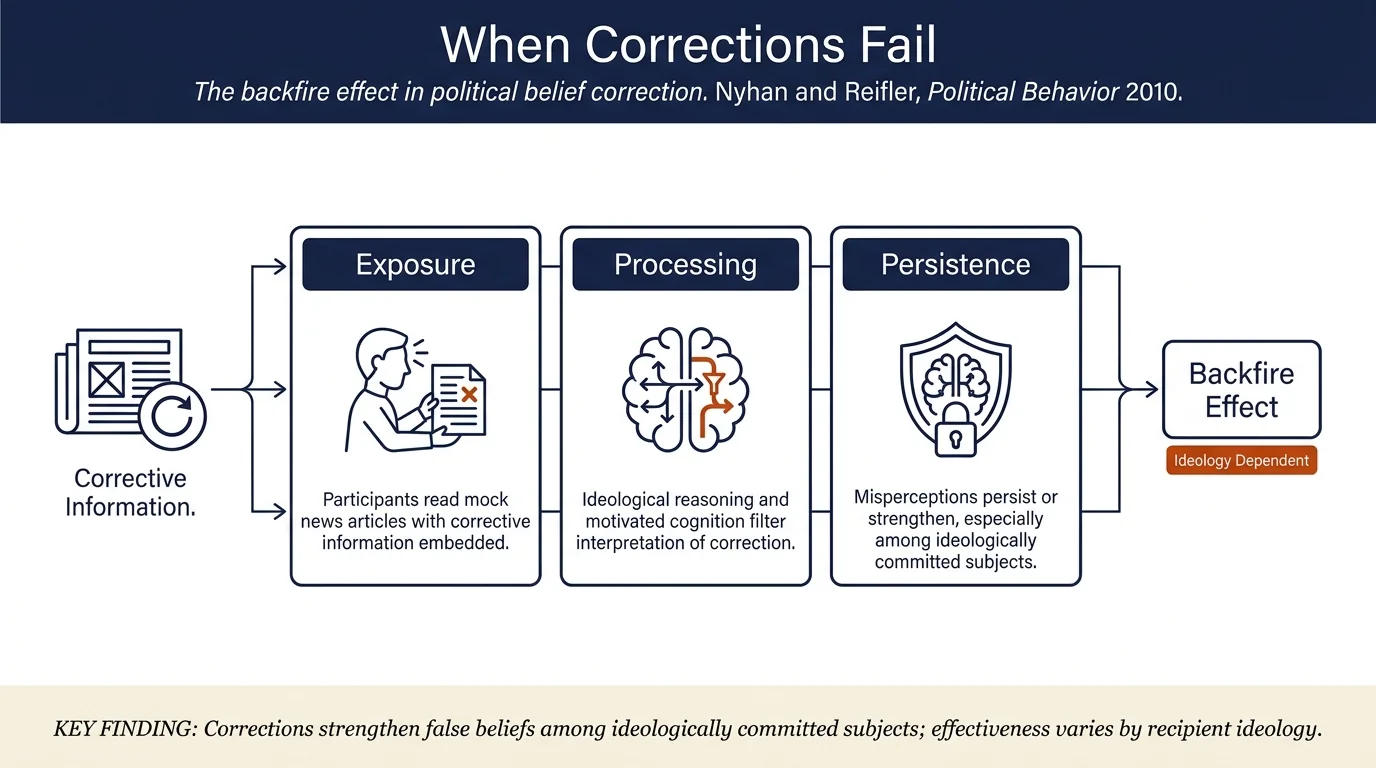 Detection methodsPsychology & interventions
When Corrections Fail: The Persistence of Political Misperceptions