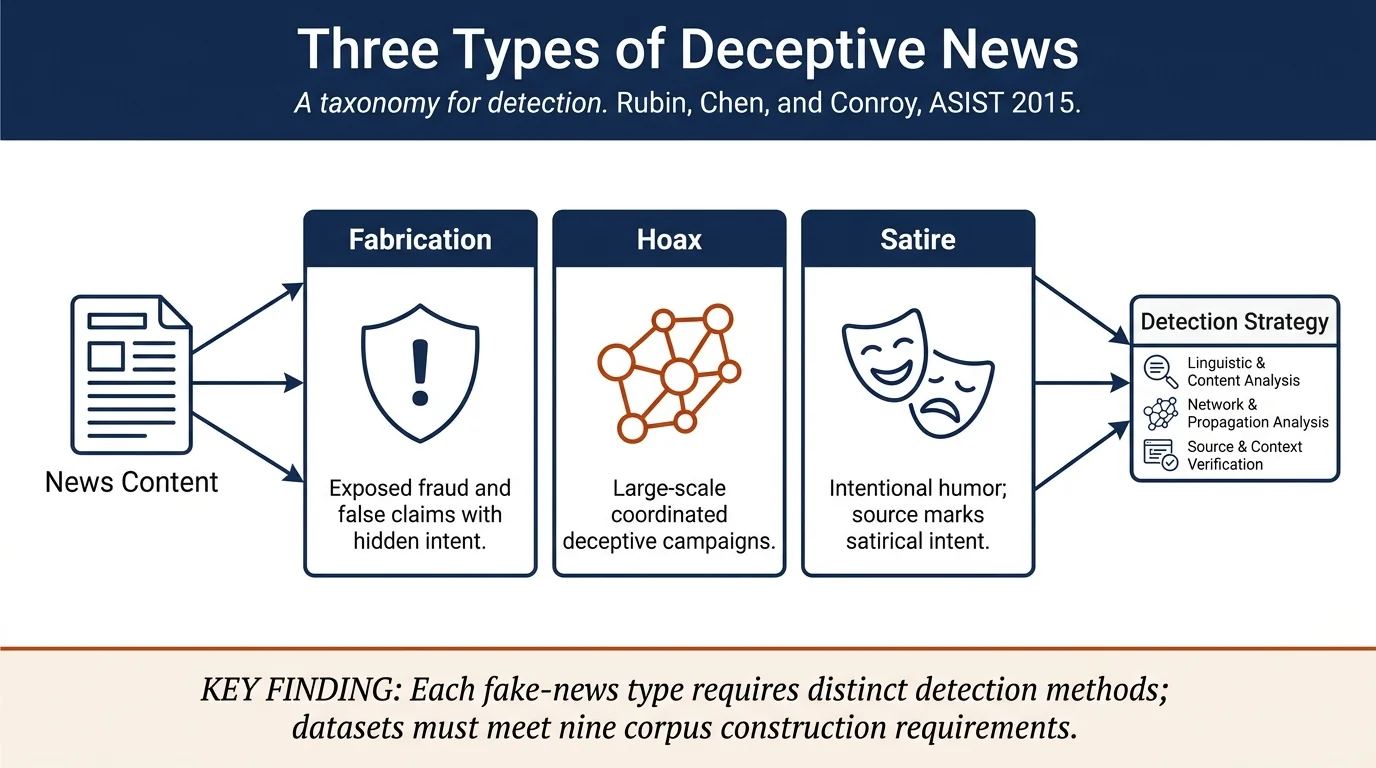
Corpus construction for fake news and misinformation detection involves systematic collection, annotation, and curation of labeled datasets of truthful and deceptive news items. Quality corpus design directly impacts model generalization and the validity of downstream research findings.
Key requirements
2015-rubin-deception-detection-news articulates nine foundational corpus construction requirements that remain central to dataset design:
- Availability of both truthful and deceptive instances — Predictive models require balanced positive and negative examples to identify patterns and regularities.
- Digital textual format accessibility — Text is the preferred medium for NLP; images and videos require transcription or conversion to text.
- Verifiability of ground truth — Established credible sources (legacy journalism outlets, fact-checked corpora) provide reliable positive labels; exposed fabrications and documented hoaxes provide negatives. Crowdsourced ratings have been used but are less reliable than expert verification.
- Homogeneity in lengths — Comparable article lengths prevent length bias in model training; short tweets, Facebook summaries, and long-form op-eds should not be mixed.
- Homogeneity in writing matter — Corpus should align on genres (breaking news, editorials, op-eds) and topics (business, politics, science, health) to control for confounding factors; similarly, should use comparable author types (professional journalists vs. citizen journalists).
- Predefined timeframe — Collection within a specific temporal window reduces spurious temporal variation; a snapshot of breaking daily news varies differently than news on a single topic over 2–3 years.
- Manner of news delivery — Context for humor, sensationalism, absurdity, and believability; satire and game shows may require different handling than fabrications since readers' initial bias shifts with awareness of intent.
- Pragmatic concerns — Copyright costs, public availability, ease of obtaining, suitable volume, disclosure degrees, and writers' privacy.
- Language and culture — English dominates; cultural and linguistic differences are often overlooked; cross-lingual evaluation is rare.
Challenges
- Ground-truth verification at scale — Establishing definitive labels for borderline cases (e.g., biased reporting vs. false reporting) or stories later corrected remains difficult.
- Representativeness — Corpora often concentrate on specific domains (elections, COVID-19) or platforms (Twitter), limiting generalization.
- Label drift — Veracity judgments may change over time (a claim that was disputed later becomes verified or vice versa).
- Annotation bias — Crowdsourced annotators may exhibit systematic biases based on political affiliation, demographic background, or platform literacy.
Key papers
- 2015-rubin-deception-detection-news — Foundational framework for corpus construction with nine systematic requirements.
- 2017-perez-rosas-fake-news-detection-datasets — Introduces FakeNewsAMT dataset; analyzes corpus design trade-offs across multiple domains.
- 2017-wang-liar-dataset — LIAR dataset: 12,836 labeled political statements from PolitiFact; demonstrates fine-grained veracity labels (6-way) and rich metadata.
Related topics
- fake-news-datasets — Existing corpora and benchmarks.
- annotation-best-practices — Methodology for reliable labeling.
- crowdsourcing — Distributed labeling approaches.
Notes
Corpus quality is a primary bottleneck in fake news detection research. Many published results depend critically on corpus design choices that may not generalize beyond the original task; for instance, a model trained on political fake news from a specific election period may perform poorly on health misinformation or cross-temporal generalization. Recent work increasingly emphasizes dataset documentation, bias analysis, and multi-domain evaluation to address these concerns.