Explore everything
Filter by research area, year and venue. Every filter is in the address bar, so you can share a view as a link.
 Psychology & interventionsPlatforms, policy & society
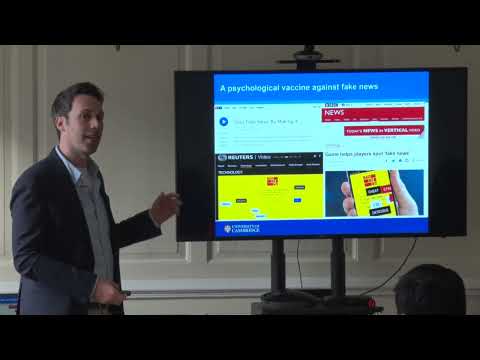
Psychological Inoculation Against Misinformation (Trinity College, Cambridge)Van der Linden presents psychological inoculation as an alternative to reactive fact-checking. Rather than debunking false claims after people have been exposed, inoculation preemptively builds resistance to misinformation techniques.
 Psychology & interventionsPlatforms, policy & society
Prebunking and Inoculating Against DisinformationVan der Linden argues that reactive fact-checking fails to scale and leaves misinformation's psychological influence intact. Instead, he proposes psychological inoculation: preemptively exposing people to weakened examples of misinformation techniques before they encounter the real thing, building cognitive resistance.
 Psychology & interventionsLLMs & generative AI
Misinformation and Data LiteracyData and numbers are surprisingly effective misinformation tools because they convey false authority and precision—people trust numbers even more than words. West illustrates how charts can deliberately mislead through axis manipulation, bin-width distortion, and selective framing; these occur regularly in mainstream media and academic…
 Spread & networksPlatforms, policy & society
Misinformation (Last Week Tonight with John Oliver)Immigrant diaspora communities face disproportionate exposure to misinformation spread through private messaging apps (WhatsApp, WeChat, KakaoTalk) rather than public social media. Platforms invest 13% of moderation resources on 90% of non-US users; messaging apps' encrypted, group-based design makes content invisible to fact-checkers;…
Platforms, policy & societyBots & coordinated campaigns
How to Counter Russian Social Media Influence in Eastern EuropeRussia deploys sophisticated social media campaigns in Eastern Europe using state-funded media, coordinated troll and bot networks, fake hashtags, and nonattributed comments to sow dissent against neighboring governments and NATO. The RAND study analyzed social media data and expert interviews to identify counter-strategies: accelerating…
Spread & networksBots & coordinated campaigns
Media Manipulation and Disinformation OnlineInternet subcultures including trolls, gamergaters, white nationalists, and conspiracy theorists exploit online platforms' vulnerabilities—algorithmic amplification, engagement metrics, and participatory culture—to manipulate news frames and spread disinformation. These diverse groups employ coordinated tactics (memes, bots, strategic…
Platforms, policy & societyPsychology & interventions
Lexicon of Lies: Terms for Problematic InformationWords matter in describing problematic information. This guide clarifies distinctions between misinformation (unintentional inaccuracy), disinformation (deliberate deception), propaganda, publicity, gaslighting, and related terms.