Explore talks and videos
Filter by research area, year and venue. Every filter is in the address bar, so you can share a view as a link.
 Psychology & interventionsPlatforms, policy & society
The dangers of the partisan brainOur brains are shaped by partisan identity to perceive reality differently, even when presented with identical evidence. Research shows that both liberals and conservatives reject factual information that contradicts their political beliefs—a phenomenon driven by motivated reasoning, structural differences in brain architecture, and…
 Deepfakes & multimodalFact-checking & verification
Presenting: The Bellingcat Online Open Source Investigations ToolkitBellingcat presents their newly restructured Online Open Source Investigations Toolkit, an AI-powered search interface that aggregates tools for digital verification and investigative research. The toolkit provides categorized access to resources for satellite imagery, social media analysis, transportation tracking, and source archiving,…
 Psychology & interventionsFact-checking & verification
Psychological Inoculation Against MisinformationSander van der Linden surveys the psychology of misinformation susceptibility and defends the approach of psychological inoculation (pre-bunking) over fact-checking (debunking). He introduces the MIST (Misinformation Susceptibility Test), a psychometrically validated instrument for measuring individual variation in susceptibility to…
 Psychology & interventionsDetection methods
Fact or Fake? The Psychology of MisinformationEcker presents an overview of misinformation psychology, covering definition, sources, behavioral impacts, and evidence-based interventions. He demonstrates that misinformation influences reasoning even after people receive corrections (the continued influence effect), and that corrections are only partially effective.
 Deepfakes & multimodalPlatforms, policy & society
Digital Forensic Expert Breaks Down Political DeepfakesFarid surveys the state of deepfake technology in the 2024 election cycle, demonstrating how synthetic images, audio, and video are weaponized to manipulate voters through fake endorsements, false statements, and inauthentic imagery. He details forensic detection techniques—perspective geometry, shadow physics, lip-sync analysis—that…
 Psychology & interventionsFact-checking & verification
Psychological Inoculation Against MisinformationSander van der Linden introduces psychological inoculation as a scalable alternative to fact-checking for building societal resistance to misinformation. Drawing on inoculation theory and his flagship intervention, the Bad News game, he demonstrates how preemptively exposing people to weakened examples of six core manipulation techniques…
 Psychology & interventionsPlatforms, policy & society
Rumors, Truths, and Reality: Political Misinformation in the Modern DayAdam Berinsky surveys a decade of research on why Americans believe political rumors despite contradictory evidence. He identifies two key mechanisms: conspiratorial thinking (a personality trait that varies across individuals) and partisanship (which structures which rumors a person is likely to endorse).
 Psychology & interventionsDetection methods
The Continued Influence of MisinformationUllrich Ecker presents research on the continued influence effect—the phenomenon that misinformation continues to shape people's reasoning and memory even after they receive corrections and understand them. He examines four social factors that shape this effect: source credibility (trustworthiness matters more than expertise),…
 Platforms, policy & societySpread & networks
How You Can Help Transform the Internet into a Place of TrustWardle examines the systemic challenges of moderating harmful content at internet scale while preserving freedom of expression. She argues that the core problem is not technical (AI could theoretically detect violations) but structural: platforms and governments lack clear authority to decide what constitutes harmful speech, face…
 Psychology & interventionsFact-checking & verification
Why People Believe Fake News, Myths & Conspiracy TheoriesBrendan Nyhan surveys research on why people hold false beliefs about politics, health, and conspiracy theories despite exposure to corrective information. He identifies two core mechanisms: selective exposure (people seek out information matching their worldview) and selective acceptance (people dismiss contradictory information through…
 Fact-checking & verificationPsychology & interventions
How to separate fact and fiction onlineMarkham Nolan, editor of Storyful, explains how journalists use open-source intelligence tools to verify content in the age of information overload. Through real-world case studies—including fake Hurricane Sandy photos and identifying locations in Syrian conflict videos—he demonstrates that truth-seeking requires human judgment combined…
 Detection methodsPlatforms, policy & society
Truth DecayTruth Decay—the erosion of reliance on facts and data in policy-making and civil discourse—is not new but cyclically emerges during periods of technological disruption in media. Kavanagh traces this through yellow journalism, radio demagoguery, cable news, and now social media.
 Psychology & interventionsDetection methods
The Psychology of MisinformationEcker presents evidence that misinformation continues to influence reasoning even after people receive, believe, and remember corrections. Drawing on cognitive psychology, he demonstrates that corrections are only partially effective—typically halving (not eliminating) reliance on misinformation.
 Psychology & interventionsPlatforms, policy & society
Prebunking and Inoculating Against DisinformationVan der Linden argues that reactive fact-checking fails to scale and leaves misinformation's psychological influence intact. Instead, he proposes psychological inoculation: preemptively exposing people to weakened examples of misinformation techniques before they encounter the real thing, building cognitive resistance.
 Psychology & interventionsPlatforms, policy & society
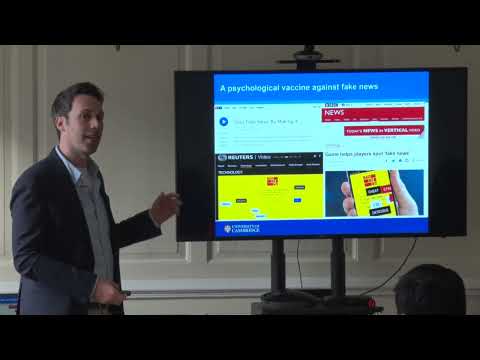
Psychological Inoculation Against Misinformation (Trinity College, Cambridge)Van der Linden presents psychological inoculation as an alternative to reactive fact-checking. Rather than debunking false claims after people have been exposed, inoculation preemptively builds resistance to misinformation techniques.
 Psychology & interventionsFact-checking & verification
How You Can Help Combat Fake NewsA researcher presents empirical findings challenging the "motivated reasoning" account of why people believe false headlines. Instead, a multi-study investigation with 25,000+ participants shows that critical thinking and cognitive reasoning—not willful bias—are the primary determinants of misinformation susceptibility.
 Platforms, policy & societyFact-checking & verification
How Polarization Can Help Solve the Misinformation ProblemDavid Rand presents a counter-intuitive argument: while polarization is widely viewed as exacerbating misinformation, it may actually improve crowd-sourced fact-checking systems like Twitter's Birdwatch/Community Notes. Rather than a traditional technology approach (machine learning classifiers), platforms can scale fact-checking by…
 LLMs & generative AIFact-checking & verification
Factuality Challenges in the Era of Large Language ModelsNakov surveys the twin challenges posed by large language models (LLMs) to misinformation detection and fact-checking: (1) LLMs generate coherent, persuasive, and factually-unreliable text—hallucinations are pervasive and often hidden; (2) LLMs can be weaponized to automate misinformation production at scale through paraphrasing, persona…