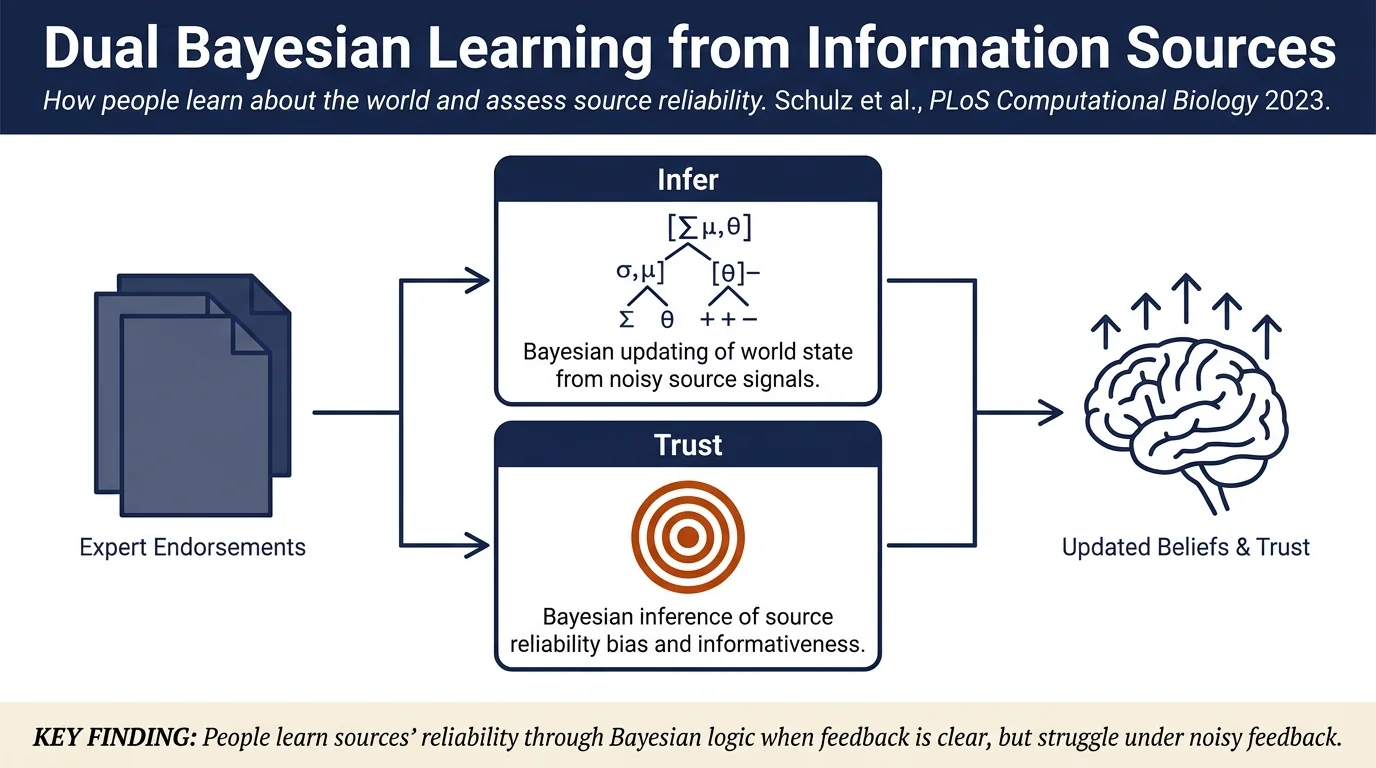
Contributions
- Formalizes source trustworthiness assessment as a doubly Bayesian learning problem: learning ground truth and source reliability parameters simultaneously
- Develops a novel "news station" task that isolates how people learn from multiple information sources with known biases and reliabilities in a tightly controlled setting
- Shows participants follow Bayesian learning dynamics in full feedback conditions but exhibit systematic biases (helpful prior, difficulty detecting subtle bias) in noisy feedback
- Demonstrates that Bayesian models with fitted parameters capture individual participant learning patterns better than parameter-free alternatives
Method
The core framing is two-level Bayesian inference: at level 1, participants learn the state of the world (which policy is better) from noisy information; at level 2, they learn about each source's trustworthiness parameters $b_f$ (bias toward one option) and $g_f$ (general informativeness). Participants interacted with a "News Station Council" panel of five experts, each endorsing either blue or green policy options with frequencies controlled by an underlying distribution.
Experiment 1 (Full Feedback): Participants saw news station endorsements (28 trials), then received ground truth feedback about the correct policy. They learned about four source types: helpful ($b_f = g_f = 0.75$), random ($b_f = g_f = 0.5$), opposite/lying ($b_f = g_f = 0.25$), and blue-biased ($b_f = 0.9$, $g_f = 0.5$). The dual learning task was reflected in equation form as marginalizing over source parameters:
$$p(s_t | X_t, H_t) \propto \iint p(b_i, g_i | H_t) P(X_t | s_t; b_i, g_i) p(s_t) \, db_i \, dg_i$$
Experiment 2 (Noisy Feedback): Participants saw the same news station endorsements but received feedback only from an "Independent Council" panel (also with known $b_Y$), making the feedback noisy and requiring more complex inference about source quality.
The model was fit to individual participant responses using hierarchical Bayesian regression, capturing trial-by-trial belief updating about both the state and source parameters.
Results
Full Feedback: Participants demonstrated strong learning convergence. Response slopes (confidence in blue policy based on blue endorsements) matched Bayesian predictions ($r = 0.92, p < 0.0001$ for model vs. data). Participants correctly distinguished source types: helpful and blue-biased sources had positive response slopes; opposite sources had negative slopes. Learning showed trial-by-trial Bayesian dynamics: participants' average accuracy in guessing the correct policy climbed from 50% to >80% by block 4, mirroring the model's predictions. However, intercept patterns revealed a "helpful prior"—participants initially assumed sources were slightly helpful even without evidence.
Noisy Feedback: Learning was substantially slower. Participants reached only ~65% average accuracy (compared to >80% in full feedback). Random source responses were higher-sloped than optimal, suggesting participants struggled to identify uninformative sources. The blue-biased source's bias was particularly hard to detect under noisy feedback; slopes were nearly flat, indicating participants barely distinguished it from the random source. Model fits showed weaker correlation between model predictions and data ($r = 0.17, p = 0.0003$ for intercepts), pointing to systematic learning failures under ambiguity.
Individual Differences: Participants' prior beliefs (initial assumptions about source quality) varied considerably, with means skewed toward assuming sources were helpful. This heterogeneity explains variance in learning speed and final accuracy. Parameter estimates showed participants updated beliefs about source quality during the task (updating ratios centered around 1.0), indicating they were performing belief revision despite sometimes failing to detect biases correctly.
Notes
Strengths: The paper presents a rare, rigorous computational characterization of the dual-learning problem in a tightly controlled lab setting. The experimental paradigm isolates confounds (participants control information sequencing, sources' actual statistics are known) that plague field studies. Bayesian model fitting to individual trajectories offers novel insights into heterogeneous learning patterns and systematic biases like the "helpful prior." The noisy feedback condition captures an important real-world constraint: feedback about source quality is often incomplete.
Limitations: The abstract task (green/blue policy preference) is far removed from real misinformation (false claims about vaccines, elections, etc.). Participants had no prior knowledge of sources and learned in isolation—real source credibility assessment involves social learning and prior beliefs. The model assumes rational Bayesian updating; it does not explain why participants show systematic biases like the helpful prior. No data on how well task performance predicts real-world news source trust or misinformation susceptibility. The paper focuses on individual learning; it does not address how social dynamics, group identity, or platform algorithms shape source trustworthiness judgments.
Future work: Test whether the model's predictions transfer to realistic news scenarios and whether experimentally observed biases correlate with field-measured misinformation vulnerability. Investigate the social and motivational origins of the helpful prior and other systematic deviations from optimality.