 Preslav Nakov
Contributions
- An evaluation framework capturing predictions, explanations, and confidence scores for multimodal fact-checking
- Comprehensive empirical assessment of GPT-4V and open-source vision-language models across Fauxography, COSMOS, MOCHEG, and a new Post-4V dataset
- Analysis of model accuracy, bias, calibration, and explanation quality across three dimensions
- Taxonomy of six failure categories for MLLMs in fact-checking: Lack of Knowledge, Similar Images, Distortion/Perspective, Incomplete Verification, Blurry/Incomplete Images, and Ambiguous Claims
- Evidence that prompt ensembles and in-context learning improve open-source model performance
Method
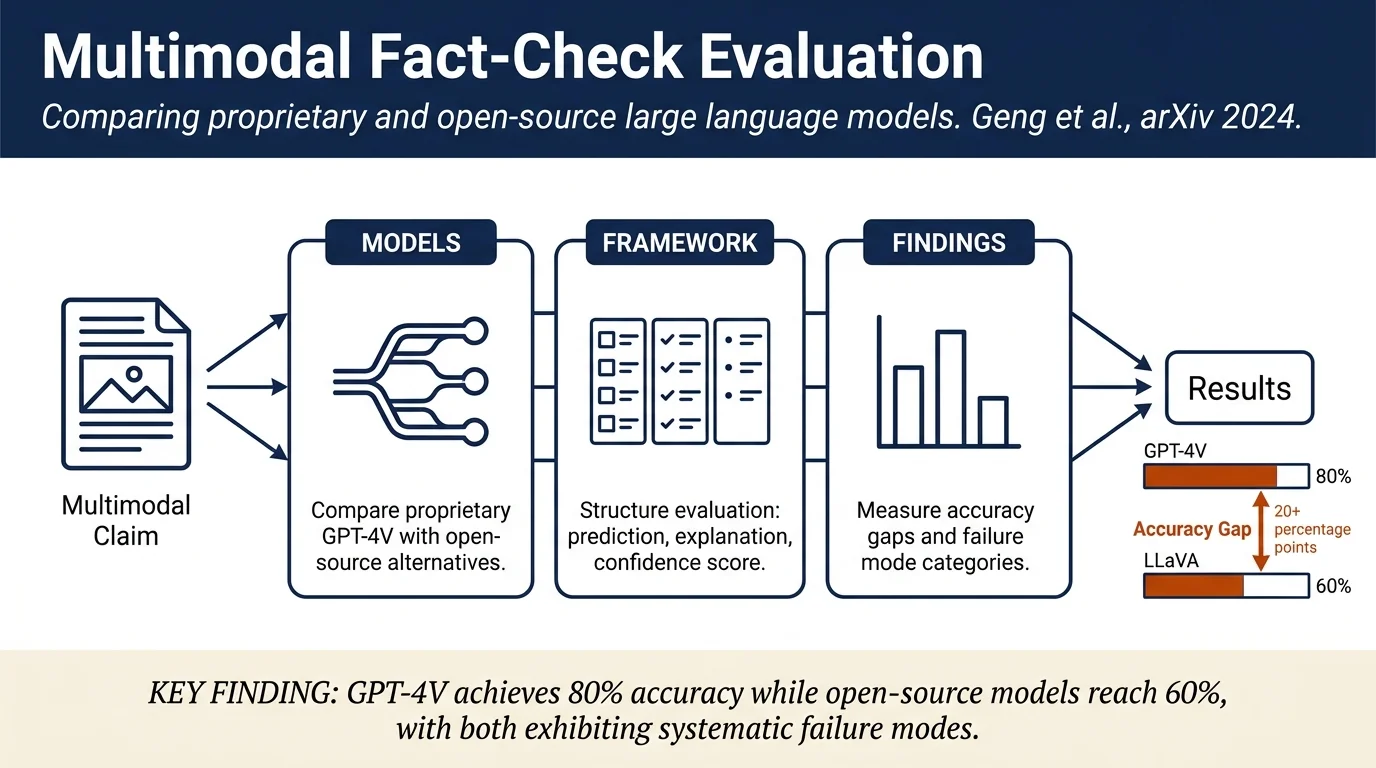
The paper evaluates MLLMs via a structured prompt that requests three components:
- Prediction (True/False/Uncertain) for the given multimodal claim
- Explanation (evidence and step-by-step reasoning)
- Confidence score (percentage)
The framework is applied across multimodal fact-checking datasets. Models are evaluated with and without images to quantify the contribution of visual information. Two prompting strategies are explored:
- Prompt Ensembles (PE): Multiple semantically similar prompts aggregated to reduce variance
- In-Context Learning (ICL): Demonstrations (1-2 examples per claim) to improve reasoning
Models tested: GPT-4V, MiniGPT-v2, LLaVA-7b, LLaVA-13b, and variants with PE/ICL.
Evaluation metrics include True&False Accuracy (strict classification), Overall Accuracy (accounting for Uncertain responses), and categorical analysis of predictions (True/False/Uncertain/Others).
Results
Accuracy: GPT-4V demonstrates surprising performance exceeding 80% on three public datasets, with an accuracy rate of 79.6% on the proprietary Post-4V dataset. Open-source models significantly underperform: LLaVA-13b achieves around 60%, while MiniGPT-v2 is substantially lower. Improvements via prompt ensembles and ICL are modest for open-source models (5–10% gains on COSMOS with ICL).
Explanations: GPT-4V generates richer, more detailed explanations than LLaVA, explicitly leveraging internal knowledge and reasoning. LLaVA explanations are typically brief and often lack comprehensive reasoning. ICL significantly increases average explanation length for LLaVA (up to 3.88 sentences in Fauxography), though this does not always correlate with accuracy improvement.
Failure Analysis: Six primary failure categories emerge:
- Lack of Knowledge: Models misidentify factual claims due to incomplete knowledge (e.g., misremembering historical details)
- Similar Images: Confusion between visually similar images in different contexts
- Distortion/Perspective: Models fail to recognize optical/perspective distortions or lens effects
- Incomplete Verification: Models overlook multiple subclaims or inconsistencies
- Blurry/Incomplete Images: Models unable to discern details from low-quality or cropped images
- Ambiguous Claims: Semantic ambiguity causing conflicting interpretations
Calibration: GPT-4V confidence scores are well-calibrated overall (confidence closely mirrors accuracy), while LLaVA-13b exhibits overconfidence with clustered scores in the 70–90% range.
Images Impact: Removing images reduces GPT-4V's accuracy across all datasets (5–15% drops), showing visual information is crucial. Surprisingly, LLaVA-13b sometimes performs better on text-only claims, suggesting images can mislead open-source models.
Notes
Strengths:
- Thorough systematic evaluation across multiple state-of-the-art models and datasets
- Rich qualitative analysis of failure modes via taxonomy and case studies
- Addresses both accuracy and interpretability (explanations, confidence calibration)
- New Post-4V dataset to control for data contamination in GPT-4V
- Clear demonstration that visual information substantially impacts performance
Weaknesses:
- Limited dataset scale (200–480 samples per dataset); results may not generalize to other domains
- Evaluation focuses on static images; does not address video or temporal misinformation
- No fine-tuning explored; models evaluated in their default settings with limited prompt engineering beyond basic PE/ICL
- Open-source model performance gap suggests practical deployment challenges
Future directions:
- Integration with external knowledge bases to improve reasoning
- Domain-specific fine-tuning to reduce hallucinations
- Exploration of multimodal fact-checking with video and temporal information
- Methods to enhance open-source models' robustness to image manipulation