 Jon Roozenbeek
 Sander van der Linden
Contributions
- First empirical validation of a technique-based inoculation intervention against real-world misinformation, moving beyond fictional examples to authentic social media posts from credible sources and genuine false news items.
- Two pre-registered experiments (N=2,188 and N=968) demonstrating inoculation effects for both game-exposed and game-unexposed misinformation, with measurement of cross-protection generalization.
- Mechanistic evidence that inoculation primarily works through reduced perceived reliability of misinformation rather than increased reliability ratings of real news, with age as a significant predictor of effect magnitude.
- Detailed investigation of item effects using a Solomon-like design to isolate the Bad News intervention effect from confounds of familiarity and pre-test exposure, addressing methodological questions about generalization across different misinformation examples.
Method
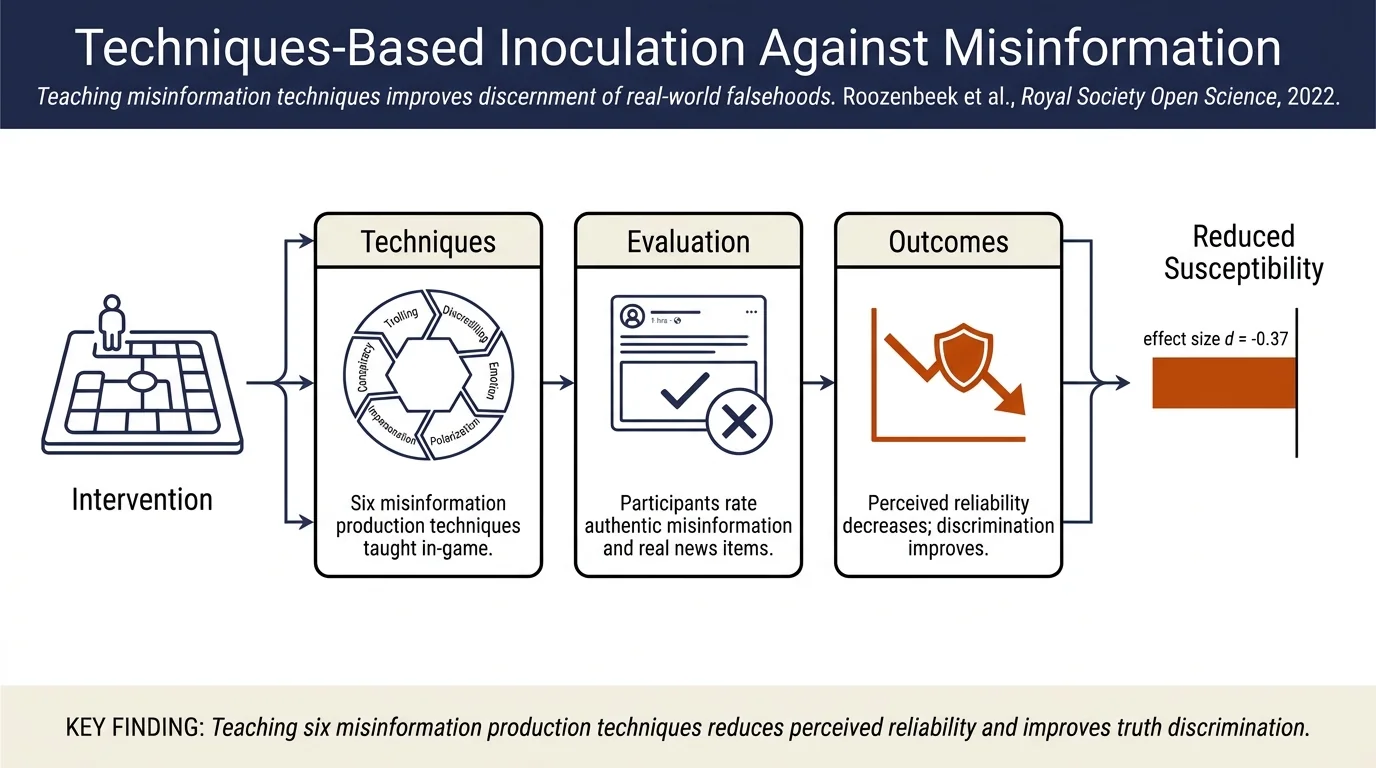
Experiment 1: Within-subject pre-post survey design. Participants (N=1,216) played the Bad News game (15 minutes) and rated nine social media posts before and after: six misinformation items using DEPICT techniques (discrediting, emotion, polarization, impersonation, conspiracy, trolling) sourced from fact-checking platforms; two real news control posts from Reuters and Associated Press; one COVID-19 false claim. Participants rated reliability on a 1–7 Likert scale (1="unreliable", 7="reliable").
Experiment 2: Two-group within-subject design addressing cross-protection and item effects. Participants (N=968) were randomly assigned to group A-B (item set A pre-test, item set B post-test) or B-A (item set B pre-test, item set A post-test), playing Bad News in between. This isolated the Bad News effect from confounds of item familiarity and pre-post differences in perceived credibility of initial item sets.
Measurement: Pre-post changes in perceived reliability for misinformation posts (primary outcome) and real news items (secondary outcome); truth discrimination (ability to distinguish false from real headlines on 1–7 accuracy scale); demographic moderation (age, gender, education, political ideology).
Results
Experiment 1: Playing Bad News significantly decreased perceived reliability of real-world misinformation posts ($d = -0.37$, 95% CI $[-0.43, -0.31]$; 64.4% of post-gameplay reliability scores lower than pre-gameplay). Cross-protection detected: perceived reliability of items matching misinformation techniques people were not inoculated against also decreased, though at a smaller effect size ($d = -0.10$). Real news reliability showed a small non-significant decrease post-gameplay ($d = -0.10$). Truth discrimination improved significantly ($d = 0.10$, 95% CI $[0.015, 0.14]$).
Experiment 2: Inoculation effect detected when comparing same items pre-post for the A-B group ($d = -0.10$, 95% CI $[-0.17, -0.04]$), supporting Hypothesis $H_1$. Cross-protection weaker: no significant decrease in perceived accuracy of real news items; truth discrimination showed a significant overall increase ($M_{discrimination,post} = 2.18$ vs $M_{discrimination,pre} = 2.06$, $d = 0.16$). Item set effects (A vs. B) influenced pre-post differences due to baseline credibility differences in the item sets themselves, suggesting item effects are present but inoculation effects still detectable.
Moderation: Age significantly predicted pre-post inoculation effect for misinformation ($p = 0.005$); older participants showed larger effects. Gender, education, and political ideology did not significantly moderate effects.
Notes
Strengths: Large, pre-registered experiments with real misinformation and real news controls; careful measurement of cross-protection; attention to item effects and confounds; mechanistic evidence (perceived reliability vs. accuracy) that clarifies the pathway of effect.
Limitations: Only two real news items used in experiment 1, limiting statistical power for real-news comparisons; cross-protection effects substantially smaller than within-technique effects, raising questions about scalability and generalization; long-term durability not tested (only immediate post-gameplay). Age moderation is detected but not deeply investigated; gender/ideology null results may reflect narrow participant sample (58% higher education).
Open questions: Whether cross-protection improves with longer/repeated inoculation; whether effects persist and decay over weeks/months; mechanisms of cross-protection (do participants learn a general skepticism heuristic or technique-specific refutation skills?); whether the perceived-reliability pathway suggests inoculation may trade off against willingness to share real news.