 Andrew M. Guess
 Benjamin Lyons
 Brendan Nyhan
 Jason Reifler
Contributions
- Presents experimental evidence that unsubstantiated voter-fraud allegations undermine election confidence
- Demonstrates that effects persist even when paired with fact-checks
- Shows effects are concentrated among Republicans and high-Trump approvers
- Finds minimal effects on Democrats, suggesting party-based polarization
- Tests whether effects extend beyond election confidence to broader attitudes toward democracy
- Provides evidence that the proliferation of unsupported fraud claims threatens democratic institutions
Method
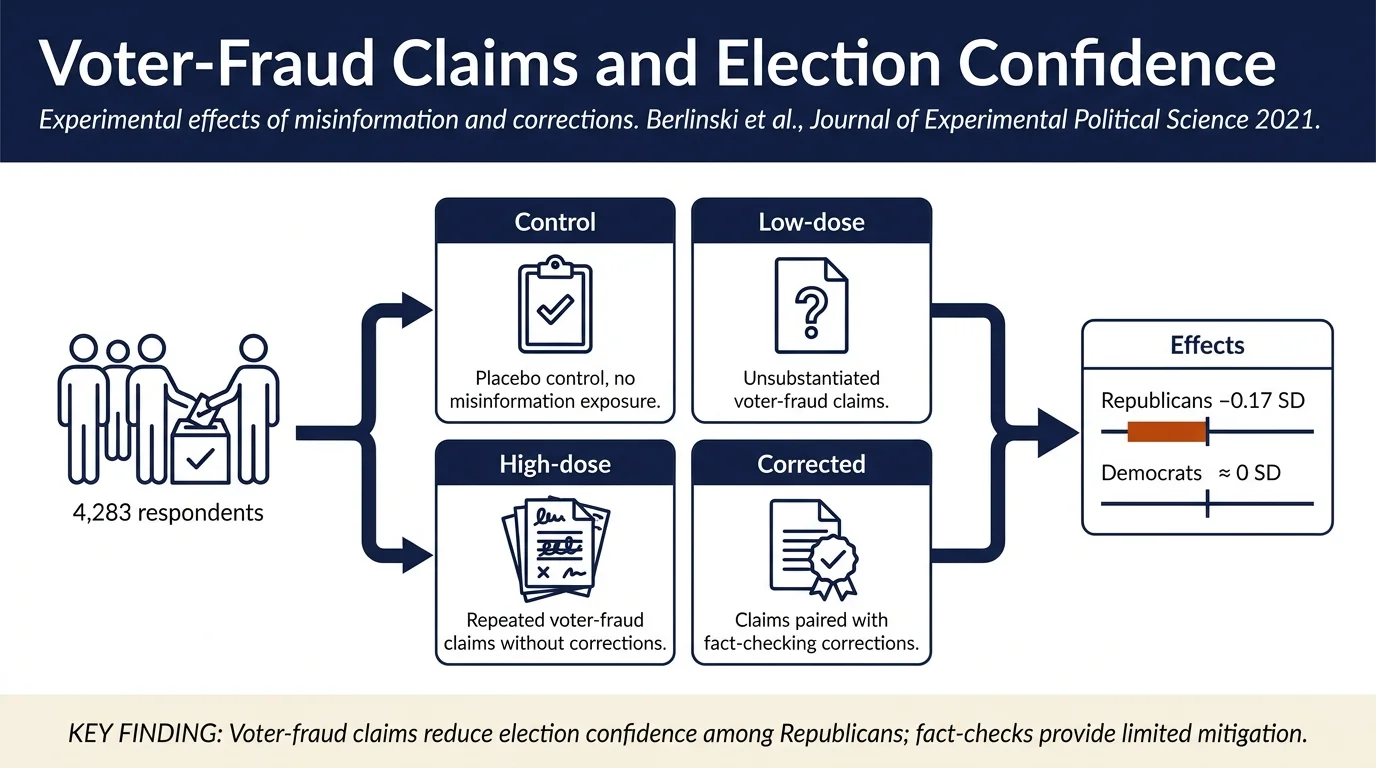
The researchers conducted a preregistered online experiment in December 2018/January 2019 with 4,283 nationally representative U.S. respondents recruited via YouGov. Participants were randomly assigned to one of four conditions:
- Placebo control: four non-political tweets
- Low-dose fraud: four tweets with unsubstantiated voter-fraud allegations
- High-dose fraud: four tweets with unsubstantiated voter-fraud allegations
- Low-dose + fact-check: four tweets with fraud allegations plus four fact-check tweets debunking those claims
The study measured election confidence using a composite index of seven items (confidence in ballot security, that elections are fairly managed, that votes are counted accurately, trust in election officials, etc.). Outcome measures were standardized, allowing treatment effects to be expressed as standard deviations. The analysis examined heterogeneous treatment effects by party affiliation and approval of President Trump.
Results
Low-dose exposure significantly reduced composite election confidence relative to placebo ($\beta = -0.147$ SD, $p < 0.05$). High-dose exposure produced similar or slightly stronger effects ($\beta = -0.168$ SD, $p < 0.05$), indicating limited dose-response variation beyond the initial exposure.
Party effects were striking: the negative effects of fraud claims on election confidence were concentrated almost entirely among Republicans ($\beta = -0.168$ SD, $p < 0.01$ for low-dose), while effects on Democrats were negligible and not statistically significant.
Approval of Trump moderated effects as well, with damage concentrated among Trump approvers ($\beta = -0.191$ SD, $p < 0.05$ in the high-dose condition).
Fact-checks did not substantially reduce the damage. The low-dose + fact-check condition still reduced election confidence ($\beta = -0.092$ SD, $p < 0.05$), showing that adding corrections to unfounded claims did not measurably eliminate the harm. Effects on Republican respondents persisted when exposed to fact-checks ($\beta = -0.176$ SD, $p < 0.05$), indicating limited mitigation.
Effects on broader democratic attitudes were largely null—the fraud claims did not substantially shift support for democracy itself in preregistered analyses, though supplementary exploratory analyses found some marginal effects.
Notes
This study is methodologically rigorous: preregistered hypotheses, transparent reporting of deviations, large nationally representative sample, and careful measurement of heterogeneous effects by political affiliation. A key strength is the focus on unsubstantiated allegations—the study isolates the effect of unsupported claims independent of actual fraud, which is rare in the literature.
The finding that fact-checks fail to fully restore confidence is particularly important for election administration and media literacy. The persistence of damage even under correction suggests that the volume, prominence, and partisan source of accusations matter as much as accuracy. This has implications for how platforms and fact-checkers should approach allegations of voting irregularities.
One limitation is the reliance on Twitter-based stimuli from 2018/2019, before the most visible voter-fraud claims of 2020–2021. The authors conducted this study in the aftermath of the 2018 midterms specifically to isolate exposure effects from the downstream consequences of a contested election, but future work should test whether results hold under the more heated conditions of a presidential election cycle contested in real-time.