 Pepa Atanasova
 Alberto Barrón-Cedeño
 Giovanni Da San Martino
 Preslav Nakov
Contributions
- Formalizes check-worthiness prediction as a ranking task: given a transcript of debate/speech, rank sentences by likelihood they should be fact-checked.
- Introduces the CT-CWC-18 dataset with 8,946 English and 7,254 Arabic sentences annotated for check-worthiness, based on the 2016 US Presidential Campaign.
- Conducts a systematic evaluation of multiple approaches (neural networks, SVM variants, ensemble methods) and feature representations (word embeddings, POS tags, named entities, syntactic dependencies, sentiment).
- Provides a freely available dataset and scoring scripts for further research on check-worthiness estimation.
Method
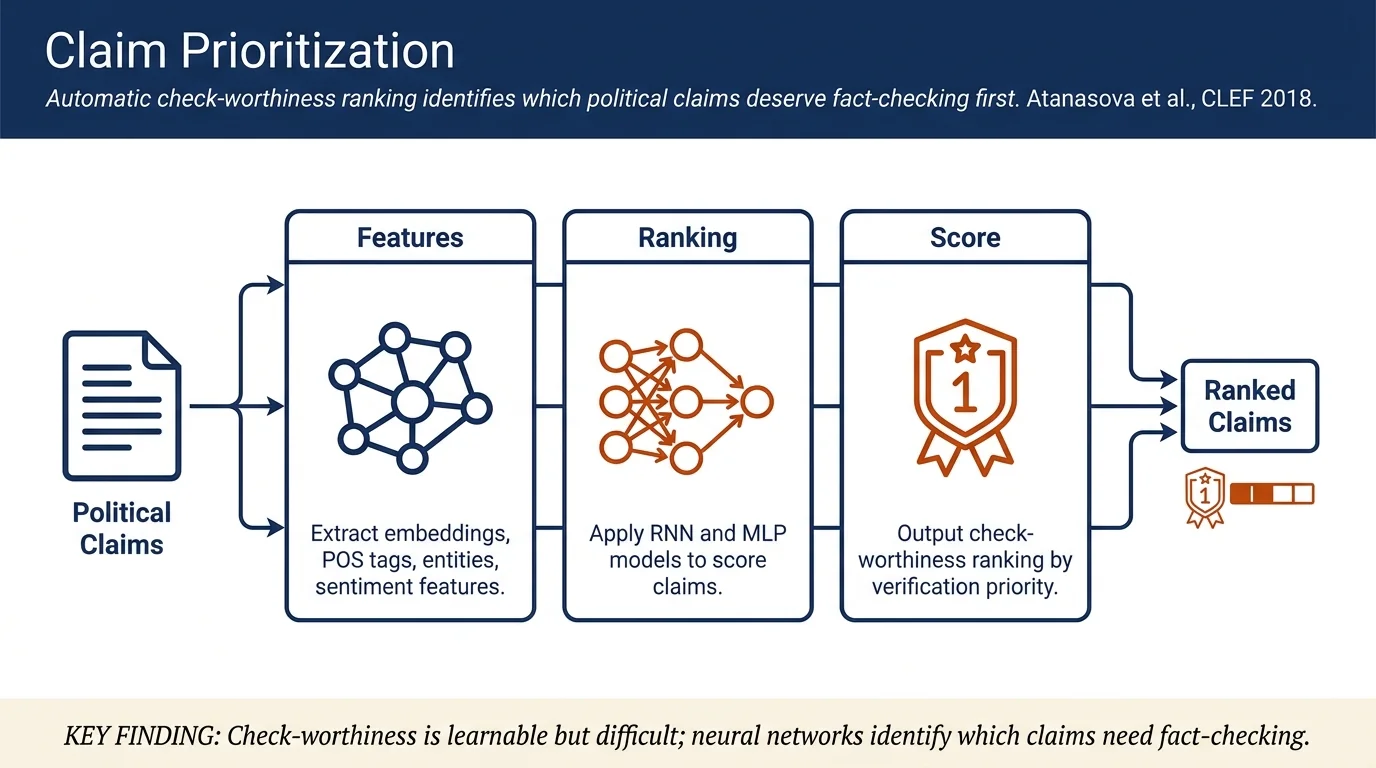
The task is framed as ranking problem where systems predict which claims in a political debate should be prioritized for fact-checking. Participating systems used a range of approaches:
Learning models: Recurrent neural networks, multilayer perceptrons, support vector machines, random forests, k-nearest neighbors, and gradient boosting.
Representations: Word embeddings, character n-grams, part-of-speech tags, verbal forms, negations, named entities, sentiment labels, topics, and syntactic dependencies.
The dataset comprises four debates and five speeches from the 2016 US Presidential Campaign. Annotations were gathered from fact-checking organizations, marking sentences that were checked or should have been checked. Evaluation uses mean average precision (MAP) as the primary metric.
Results
English test set (5 debates + speeches):
- Best primary system (Prise de Fer): MAP = 0.1832
- Best unofficial run (Copenhagen): MAP = 0.1611 (using recurrent neural networks)
- Mean of all systems: approximately 0.14
Arabic test set (2 debates + 1 speech):
- Best system (bigIR): MAP = 0.0899
- UPV-INAOE-Autoritas: MAP = 0.0461 (best on official measure)
- Speeches found to be easier than debates for check-worthiness prediction
The best-performing approaches combined recurrent networks with multilayer perceptrons, used multiple feature representations, and incorporated vocabulary matching against claim databases.
Notes
The shared task reveals significant room for improvement on this problem: even the best-performing systems achieve only ~18% MAP on English. The discrepancy between English and Arabic results suggests language-specific challenges (potential artifacts of translation in the Arabic dataset). The paper demonstrates that check-worthiness is a learnable but difficult subtask distinct from claim verification itself; future work should explore multi-task learning that combines check-worthiness with factuality prediction.