 Isabelle Augenstein
 Andreas Vlachos
 Kalina Bontcheva
Contributions
- Conditional LSTM encoding that learns target-dependent tweet representations, enabling zero-shot transfer to unseen targets
- Bidirectional extension of conditional encoding to improve context modeling
- Demonstration that unsupervised pre-training on unlabeled domain data is critical for small training sets
- Second-best performance on unseen-target stance detection without target-specific training; state-of-the-art with weak supervision
Method
The paper explores three architectures with increasing sophistication:
Independent Encoding: Two LSTMs independently encode the target and tweet as k-dimensional vectors, concatenate them, and classify via softmax. This learns target-independent tweet representations and relies entirely on the final projection layer to incorporate target information.
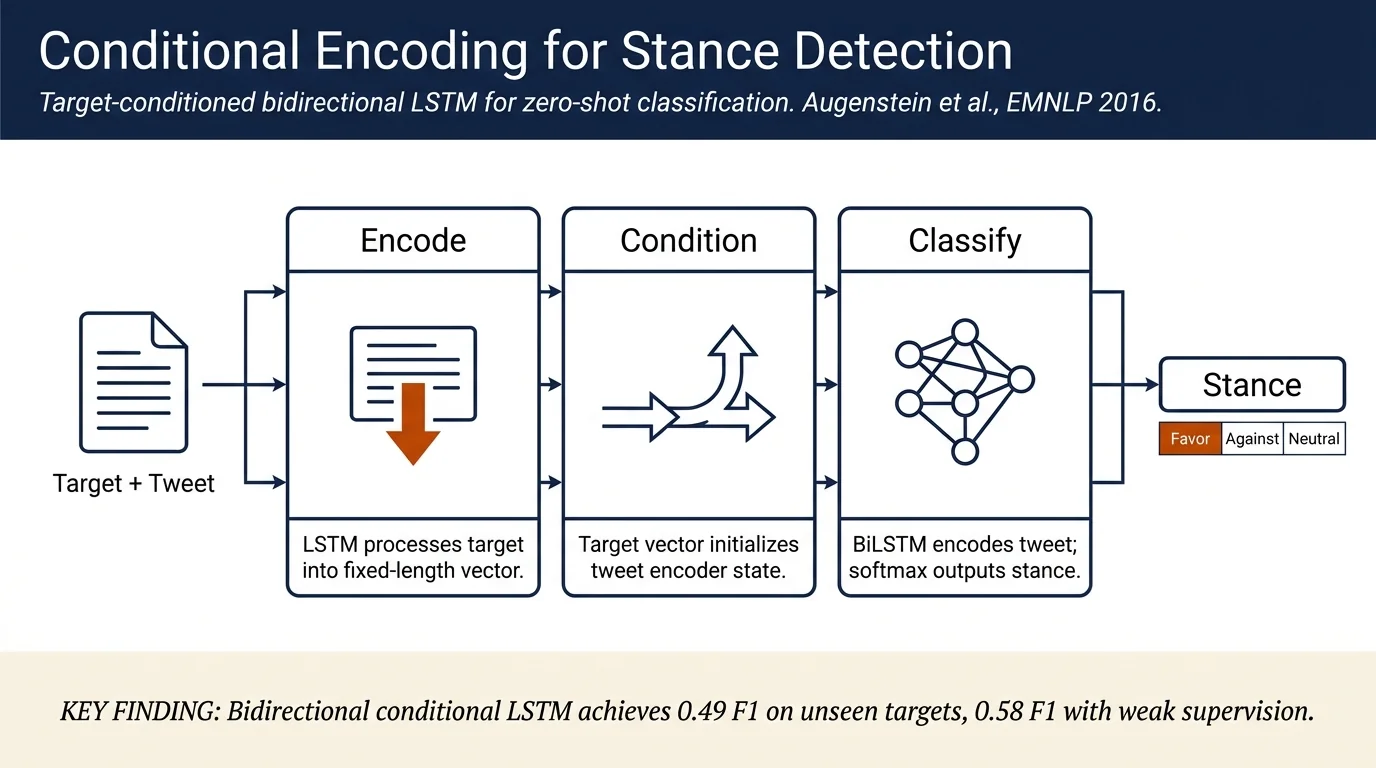
Conditional Encoding: One LSTM encodes the target as a fixed-length vector. A second LSTM encodes the tweet using this target encoding as its initial state. This forces the tweet representation to be computed in a target-specific manner: the same tweet will produce different representations depending on the target.
Bidirectional Conditional Encoding: Bidirectional LSTMs encode both target and tweet. The forward and backward final states of the target LSTM initialize the corresponding forward and backward LSTMs for the tweet. This allows the tweet encoder to consider context on both sides when representing each word, conditioned on the target.
All models are trained with word embeddings pre-trained on a corpus of 395K unlabeled tweets collected by the authors. The paper demonstrates that shared embeddings between tweet and target vocabularies outperform separate embeddings, likely because tweets often mention the targets directly.
Results
Unseen target setup (primary focus): Systems must predict stance toward Donald Trump using only training data from other targets (Climate Change, Atheism, Feminist Movement, Legalization of Abortion, Hillary Clinton). The bidirectional conditional model (BiCond) achieves a macro-averaged F1 of 0.4901—second-best among all participants, surpassing approaches that do not condition on the target by 5+ F1 points.
Weakly supervised setup: When automatically labeled training data for the test target is added (standard regex-based bootstrapping), BiCond reaches 0.5803 F1, state-of-the-art at the time, outperforming the top task submission.
Key ablations:
- Conditional encoding substantially outperforms independent encoding, validating the core hypothesis that target-specific tweet representation matters
- Bidirectional encoding adds ~0.02 F1 over unidirectional conditional encoding
- Pre-trained embeddings provide large gains (~0.04 F1) on this small dataset (5.6K labeled instances)
- The model performs substantially better when the target is mentioned in the tweet (F1 0.5515 vs 0.2660) but still learns meaningful signal when targets are absent
Notes
This is a foundational paper for computational understanding of stance as a task distinct from sentiment. The key insight—that conditioning the encoding of text on a target improves generalization—has been influential in downstream NLP work (e.g., reading comprehension, entailment). For misinformation research, stance detection on social media is a crucial signal: the paper's own motivation explicitly notes that tweets expressing actual facts are affirmed by 90% of related tweets, while those conveying false information are predominantly questioned or denied. The paper is technically sound, the experiments are thorough (including ablations on embeddings, directionality, and target presence), and the datasets are publicly available.