 Miriam Metzger
 Andrew J. Flanagin
Contributions
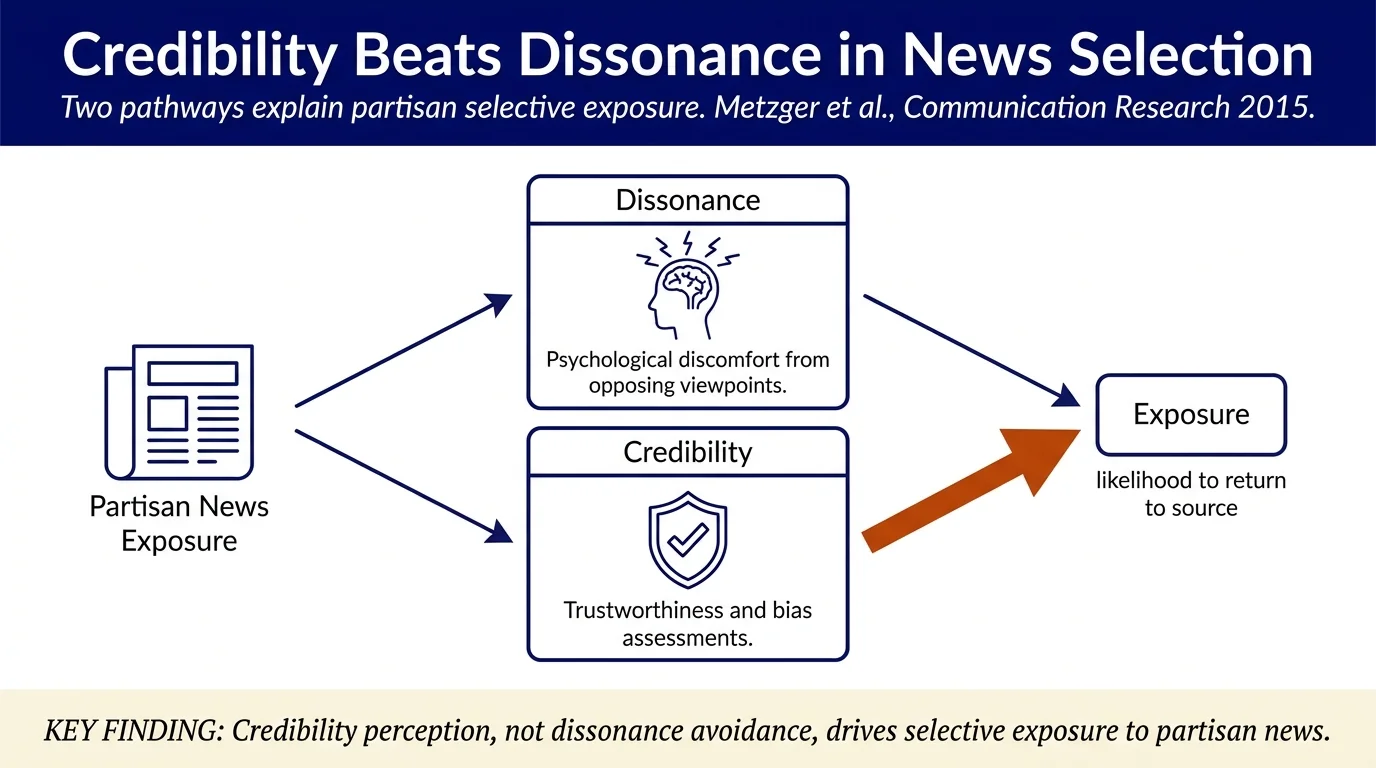
- Directly tests cognitive dissonance versus credibility perception as explanations for selective exposure to partisan news
- Provides the first empirical measure of cognitive dissonance experienced during exposure to attitude-challenging news information
- Demonstrates that people evaluate credibility at both the source level (news outlet) and the message level (story)
- Shows that credibility perception is a stronger predictor of selective exposure behavior than cognitive dissonance
- Reveals that balanced (objective) news sources are perceived as more credible than both attitude-consistent and attitude-challenging sources
- Documents the interaction between source credibility and story credibility in shaping overall information evaluation
Method
Study design: Online experiment with 3 (source balance: conservative, liberal, balanced) × 3 (story balance: conservative, liberal, balanced) between-subjects factorial design.
Participants: 2,146 adults from a probability-based panel (GTK/Knowledge Networks). Sample composition: 48.6% male, 51.4% female; 65.4% White, 10.1% Black, 10.4% Hispanic, 14.0% other; political affiliation: 34.7% Democrat, 27.8% Republican, 24.4% Independent, 5.5% Tea Party, 4.6% other. Age range: 18–94 years ($M = 49.25$, $SD = 16.03$).
Stimuli: Participants viewed one news source and read one news story on one of two political issues: (1) legalization of gay marriage in Washington, D.C., or (2) budget cuts to Planned Parenthood. Conservative stories used quotes from Republican politicians; liberal stories used Democratic quotes. Balanced stories presented perspectives from both sides. Sources were manipulated to appear conservative (FoxNews.com, RedState.com), liberal (LibOasis.com, NPR.com), or balanced (CNN.com, TheModeratVoice.com).
Dependent variables measured:
- Cognitive dissonance: New 5-item scale measuring affective and cognitive discomfort experienced while reading the news story (e.g., "I regret reading this story," "This news source makes me uncomfortable")
- Selective exposure: Self-reported likelihood of returning to the news source in the future (5-point Likert scale)
- Source credibility: 4-item scale measuring perceived bias, professionalism, and trustworthiness of the news website
- Story credibility: 5-item scale measuring completeness, accuracy, bias, unbiasedness, and trustworthiness of the news story
- Source familiarity: To control for effects of prior knowledge on credibility judgments
Results
Hypothesis 1 (Cognitive dissonance): Participants experienced significantly more cognitive dissonance when exposed to attitude-challenging sources ($M = 2.92$, $SE = 0.04$) compared to attitude-consistent ($M = 2.36$, $SE = 0.04$) or balanced sources ($M = 2.58$, $SE = 0.04$). Main effect of source attitude-consistency on cognitive dissonance: $F(2, 689) = 50.51$, $p < .001$. Hypothesis 1 supported.
Hypothesis 2 (Selective exposure): Participants reported greater likelihood of selecting attitude-consistent sources ($M = 2.52$, $SE = 0.07$) over attitude-challenging sources ($M = 1.70$, $SE = 0.06$). Main effect: $F(2, 689) = 39.43$, $p < .001$, $\eta_p^2 = .12$. Hypothesis 2 supported.
Hypothesis 3 (Source credibility): Attitude-consistent sources were rated as significantly more credible ($M = 3.05$, $SE = 0.05$) than attitude-challenging sources ($M = 2.31$, $SE = 0.05$). Main effect: $F(3, 939) = 68.76$, $p < .001$, $\eta_p^2 = .18$. Balanced sources received intermediate credibility ratings ($M = 3.14$, $SE = 0.06$), significantly more credible than attitude-challenging sources. Hypothesis 3 supported.
Hypothesis 4 (Story credibility): Attitude-consistent stories were perceived as more credible ($M = 3.00$, $SE = 0.10$) than attitude-challenging stories ($M = 2.32$, $SE = 0.08$). Hypothesis 4 partially supported.
Hypothesis 5 (Relative preference): Among nonpartisans and issue-neutrals, those who viewed balanced sources ($M = 2.38$, $SE = 0.10$) were significantly more likely to report future use compared to those who viewed unbalanced sources ($M = 1.77$, $SE = 0.07$). Hypothesis 5 supported.
Key interaction finding: Among partisans, viewing an attitude-consistent source with an attitude-consistent story yielded the highest credibility ratings ($M = 3.09$, $SE = 0.11$). The combination of attitude-challenging source and attitude-challenging story yielded the lowest credibility ratings ($M = 2.18$, $SE = 0.06$). This demonstrates that source and story attitude-consistency interact to determine overall credibility perception.
Critical finding on dissonance: Although cognitive dissonance was significantly higher for attitude-challenging sources, absolute dissonance levels were quite low overall. Most participants fell between "disagree" and "neither agree nor disagree" on the 5-point discomfort scale ($M$ values all below midpoint of 3.0). This suggests cognitive dissonance is not a powerful mechanism driving selective exposure in the partisan news context, contrary to decades of theory-driven assumptions.
Notes
This study makes an important empirical contribution by directly measuring cognitive dissonance during news exposure rather than assuming its operation. The finding that credibility perception better predicts selective exposure than psychological discomfort has significant implications for understanding polarization and designing interventions. The work tempters common narratives that frame partisan selective exposure as driven by defensive psychological mechanisms; instead, it suggests people may be rationally evaluating source trustworthiness through heuristics that unfortunately align with political preferences.
A potential limitation is that the dissonance measure relies on self-report collected immediately after exposure; other cognitive and affective dimensions of discomfort may not be consciously accessible. Additionally, the forced-choice experimental design (participants assigned to a source and story) differs from real-world selective exposure where people actively choose what to read; the lab setting may suppress the anxiety-reduction motivation that dissonance theory posits. Despite these limitations, the credibility explanation is parsimonious and consistent with how people actually report making news source decisions.
The finding that balanced sources receive high credibility ratings even from partisans is noteworthy and suggests polarization may not be as absolute as some literature assumes. Future work might examine whether perceived credibility and actual source quality are aligned, and whether interventions emphasizing credibility criteria—rather than forcing exposure to opposing viewpoints—might improve news diets without triggering defensive psychological responses.