 Jing Ma
 Wei Gao
 Kam-Fai Wong
Contributions
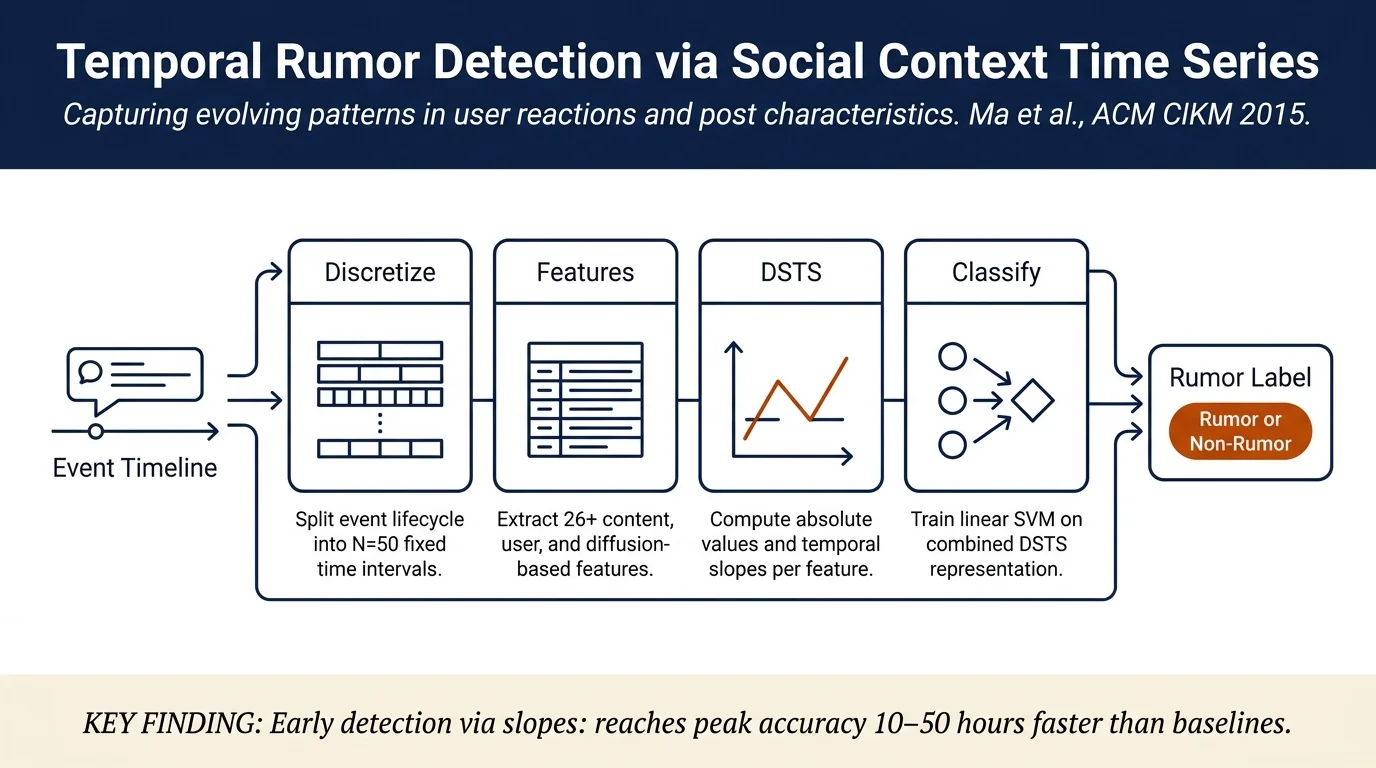
- DSTS model — a temporal feature representation that captures both absolute feature values and slopes (trends) between consecutive time intervals
- Multimodal feature engineering — 26+ content-based, user-based, and diffusion-based features with time-aware aggregation
- Early detection analysis — shows the method reaches baseline accuracy 10–50 hours faster than competing methods
- Cross-platform validation — evaluation on both Twitter (207 events) and Sina Weibo (922 events) with verified rumor labels
Method
The approach discretizes event lifecycles into N fixed time intervals (N=50 in experiments). For each interval t, features are aggregated and normalized using Z-score across all intervals.
DSTS representation (Equation 3):
- Absolute features: F^D_{i,t} for each interval t (content statistics, user attributes, retweet counts)
- Slopes: SD_{i,t} = (F^D_{i,t+1} − F^D_{i,t}) / Interval(E_i), capturing rate of change
This combines both the cumulative statistics and the temporal trajectory of each feature. A linear SVM classifier is trained on the combined DSTS feature vector.
Feature types:
- Content-based (14 features): LDA topic distributions, sentiment scores, URL/emoticon/punctuation percentages, first-person pronouns, hashtags
- User-based (10 features): verified status, follower/friend counts, account age, profile completeness, gender distribution
- Diffusion-based (3 features): retweet/comment counts, microblog volume
The key insight: static baselines (e.g., total retweets) miss that rumors and non-rumors follow different temporal patterns in question-mark usage, first-person pronouns, and sentiment evolution.
Results
Full lifecycle detection (Table 3):
- Twitter: 89.6% accuracy (10.0 point F1 improvement over DT; 4.4 point improvement over RF-ext)
- Sina Weibo: 84.6% accuracy (9.3 point accuracy improvement over DT)
- Outperforms non-linear baselines (RF, SVM-RBF) despite using a linear SVM, indicating DSTS features are highly predictive
Early detection (Figure 2):
- On Twitter, DSTS reaches RF's peak accuracy in ~15 hours; RF requires 25+ hours
- On Weibo, DSTS achieves similar performance at 20 hours; RF needs 70 hours
Notes
Strengths:
- Compelling temporal intuition with clear Figure 1 examples showing different time patterns in rumors
- Large-scale evaluation across two different platforms and languages
- Ablation studies (Table 3) show all feature types contribute; content alone is competitive
Weaknesses:
- No theoretical justification for why slopes specifically capture rumor signals; empirical finding only
- Limited to supervised classification on pre-labeled events; no zero-shot or cold-start scenarios
- Time interval discretization (N=50) appears fixed; sensitivity to this hyperparameter not explored