Warning labels (also called "fact-checker labels," "disputed tags," or "misinformation labels") are visual or textual indicators placed on content by fact-checkers or platforms to signal that a claim or post has been evaluated and found to be false, disputed, or misleading. Examples include Facebook's "Rated false" tags, Twitter/X's "Fact-checked" labels, and "Disputed" badges from third-party fact-checking organizations.
Warning labels are among the most widely deployed interventions against online misinformation, used by major platforms (Facebook, Twitter/X, Instagram, YouTube, TikTok) and fact-checking organizations globally. They operate on the principle that explicit signals of falsity will correct user beliefs and reduce sharing of misinformation.
Effectiveness mechanisms
Research identifies several psychological mechanisms by which warning labels influence user behavior:
- Direct correction: Warnings provide explicit evaluative information, prompting users to revise beliefs downward (discounting the false claim).
- Accuracy salience: Labels make the accuracy of information more cognitively salient, potentially triggering more deliberate reasoning.
- Trust in source: Effectiveness depends on user trust in the fact-checker or platform providing the label; low trust undermines impact.
- Selective exposure effect: Users may avoid sharing labeled content due to reputation concerns (Altay, Hacquin & Mercier, 2022) or concern about social judgment.
Empirical findings on effectiveness
Overall impact
- Clayton et al. (2019): Randomized experiment (n=2,944) testing "Disputed" and "Rated false" tags on Facebook; "Rated false" reduced belief by 13 percentage points; general warnings showed modest effects with spillover reducing belief in true headlines (the implied truth effect).
- Martel & Rand (2024) — Meta-analysis of 21 experiments (N=14,133): warning labels reduce false belief by 27.6% on average and sharing by 24.7% on average. Critically, effects persist even for those distrusting fact-checkers (12.9% belief reduction, 16.7% sharing reduction), suggesting labels work broadly across polarized populations.
- Bak-Coleman et al. (2022): On Twitter, fact-checking labels alone reduce engagement by ~12.7% but achieve ~53% reduction when combined with content removal, showing they scale better in multi-intervention strategies.
Moderators and limitations
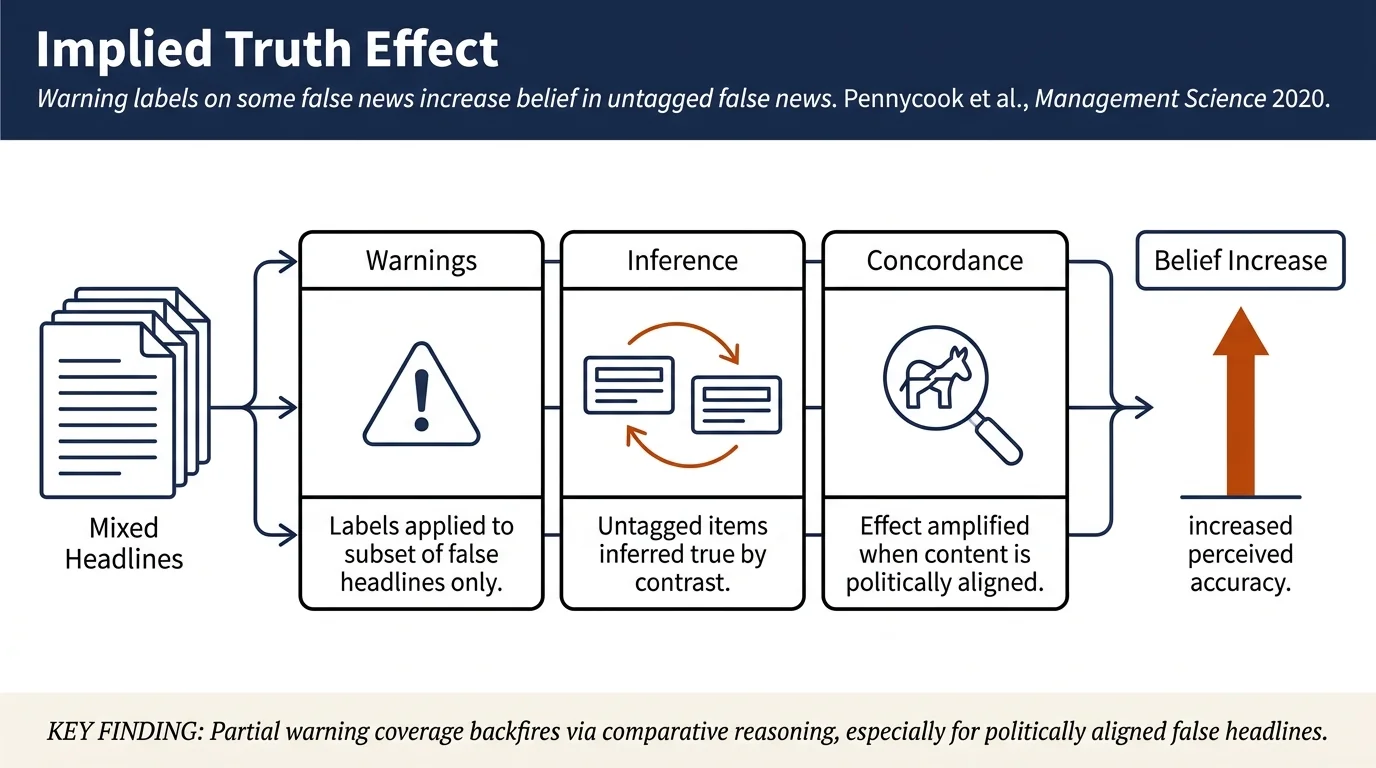
- Pennycook et al. (2020) — The implied truth effect: warning labels on false headlines can backfire by making unwarned false headlines appear more credible by contrast, particularly for politically concordant claims. Selective labeling (warnings on some but not all false headlines) creates a credibility hierarchy that can undermine overall effectiveness.
- Spillover effects: Labels on some false headlines increase perceived accuracy of unlabeled false headlines in the same environment (Pennycook et al., 2020).
- Trust heterogeneity: While Martel & Rand (2024) shows labels work even for low-trust users, effects are substantially reduced, suggesting credibility barriers matter.
- Emotional content: Labels are less effective on emotionally charged claims (the more a claim resonates emotionally, the harder a label works to correct it).
Platform implementation variance
Different platforms implement labels differently, affecting their impact:
- Facebook: "Rated false," "Rated partly false," "Missing context" labels with links to full fact-checks; platform reduces distribution algorithmically.
- Twitter/X: "Fact-checked" or "Community Notes" labels linking to verification; Community Notes uses crowd-sourced labeling (controversial efficacy).
- YouTube: Information panels linking to Wikipedia or fact-checking organizations; placed prominently for targeted misinformation keywords.
- TikTok: "Fact-checked" labels with external links.
Variation in label design (e.g., color, placement, accompanying text, source attribution) influences effectiveness, though research on design optimization is limited.
Scalability concerns
- Coverage: Fact-checkers and platform resources cannot label all misinformation; ~59% of false COVID-19 posts on Twitter went unlabeled (Brennen et al., 2020).
- Speed: By the time misinformation is fact-checked and labeled, it may have already reached millions.
- Backlash: Platform labeling can trigger accusations of bias or censorship, particularly when applied asymmetrically or perceived as politically motivated.
- Polarization: In polarized contexts, labels from platforms or fact-checkers associated with perceived outgroups may backfire or be dismissed outright.
Connections
- fact-checking — Labels are fact-checking's primary intervention; their effectiveness determines the scalability of fact-checking strategies.
- misinformation-interventions — One of nine major intervention types; meta-analysis in Kozyreva et al. (2024) categorizes labels as "refutation-strategy interventions."
- belief-formation — Labels target the belief-formation process by adding corrective information; psychological mechanisms differ from pre-bunking or inoculation.
- content-moderation — Labeling is a platform moderation strategy; often combined with algorithmic demotion or removal.
- trust — Label effectiveness is contingent on trust in the labeling source (fact-checker, platform, or crowd); low trust reduces impact.
- polarization — Polarization can undermine label effectiveness through motivated reasoning and source distrust; however, Martel & Rand (2024) shows labels remain effective even in polarized populations.
Key papers
- Martel & Rand (2024) — Meta-analysis showing warning labels reduce false belief and sharing across populations, including those distrusting fact-checkers (27.6% belief reduction on average, 12.9% for low-trust individuals).
- Clayton et al. (2019) — Early large-scale test of fact-checking tags ("Disputed," "Rated false") on Facebook; identified the implied truth effect as a critical limitation.
- Pennycook et al. (2020) — Demonstrates that warning labels on a subset of false headlines can increase credibility of unlabeled false headlines by contrast.
- Kozyreva et al. (2024) — Comprehensive review categorizing warning labels as one of nine intervention types with evidence map across 81 papers.
- Walter et al. (2020) — Meta-analysis of 30 fact-checking studies quantifying overall effectiveness (d = 0.29) and identifying moderators (motivated reasoning, political ideology).
- Wack & Warren (2026) — Observational study showing fact-checking systems label false claims far more often than confirming true ones; raises questions about asymmetric label deployment.