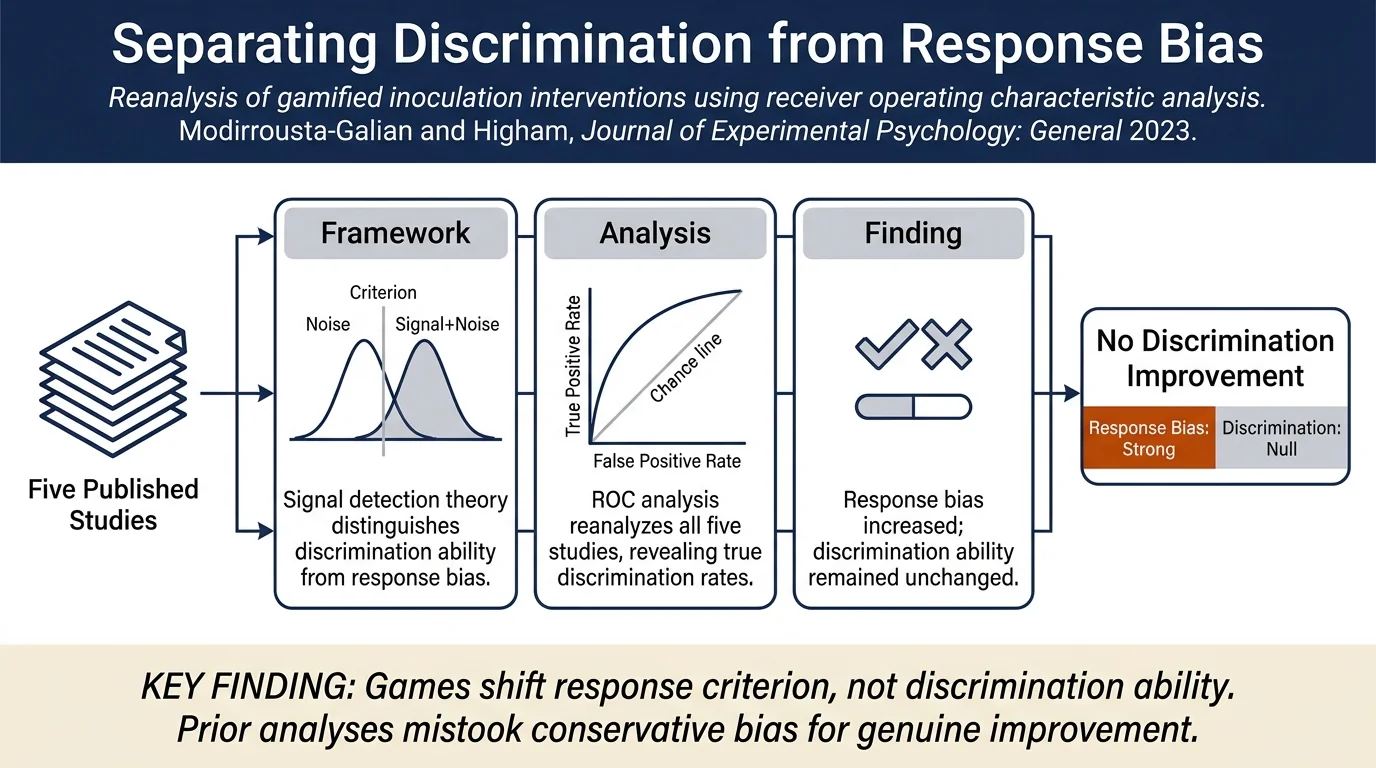
Signal Detection Theory (SDT) formalizes how observers discriminate between two types of stimuli (signal vs. noise) while accounting for individual differences in response bias. In misinformation contexts, SDT models the task of distinguishing true news (signal) from fake news (noise), with two key measurable components:
- Discrimination (d' or AUC): Ability to correctly distinguish true from false news, independent of whether the observer tends to say "true" or "false"
- Response Bias (c or B''D): Overall tendency to respond "true" or "false" regardless of item veracity (conservative vs. liberal bias)
These components often vary independently: an intervention could improve discrimination while leaving bias unchanged, worsen discrimination while introducing liberal bias, or induce conservative bias while leaving discrimination intact.
Key concepts
Gaussian Model (SDT with equal-variance assumptions):
- True news (signal) and fake news (noise) distributed as equal-variance Gaussians on an internal evidence dimension
- d' = standardized distance between distributions; d'=1 represents weak discrimination, d'=2 represents strong
- Assumes equal variance, which may not hold; violations can confound d' with bias effects
Receiver Operating Characteristic (ROC) Curves:
- Non-parametric approach plotting hit rate (HR: true news correctly rated as true) vs. false alarm rate (FAR: fake news incorrectly rated as true) across all possible response criteria
- Discrimination measured by area under the curve (AUC): 0.5 = chance, 1.0 = perfect
- Response bias visible in curve shape; conservative bias shifts curve lower-left, liberal bias shifts upper-right
- Avoids strong distributional assumptions of d', providing robust alternative
B''D Metric:
- Non-parametric measure of response bias, independent of discrimination
- Ranges from −1 (extremely liberal) to +1 (extremely conservative), with 0 = no bias
- Computable at each response criterion point across a scale
Key papers
- Modirrousta-Galian & Higham (2023) — Demonstrates ROC/SDT superiority for intervention evaluation; reanalyzes Bad News game studies showing ROC analysis reveals response bias confound missed by mean-rating approaches
- Batailleur et al. (2022) — First application of SDT to fake news research; used SDT to reanalyze prior studies and recommend ROC analysis for future research
- Higham & Higham (2018) — Theoretical paper on SDT in cognitive psychology; discusses equal-variance assumption violations
Related topics
- detection-methods — Computational and human-based approaches to identifying false news
- intervention — Designing and evaluating misinformation interventions
- psychology-of-belief — Cognitive mechanisms underlying belief formation and change
- cognitive-reasoning — Higher-order reasoning and critical thinking
Notes
SDT is underutilized in misinformation research despite its power to distinguish genuine discrimination gains from response bias shifts. Mean-rating comparisons (standard in behavioral experiments) conflate these two constructs, leading to false positives. ROC analysis has become standard in medical diagnosis (radiology, pathology) and animal cognition precisely because it cleanly separates discrimination from bias; greater adoption in information-integrity research could improve intervention evaluation rigor and prevent erroneous conclusions about effectiveness.