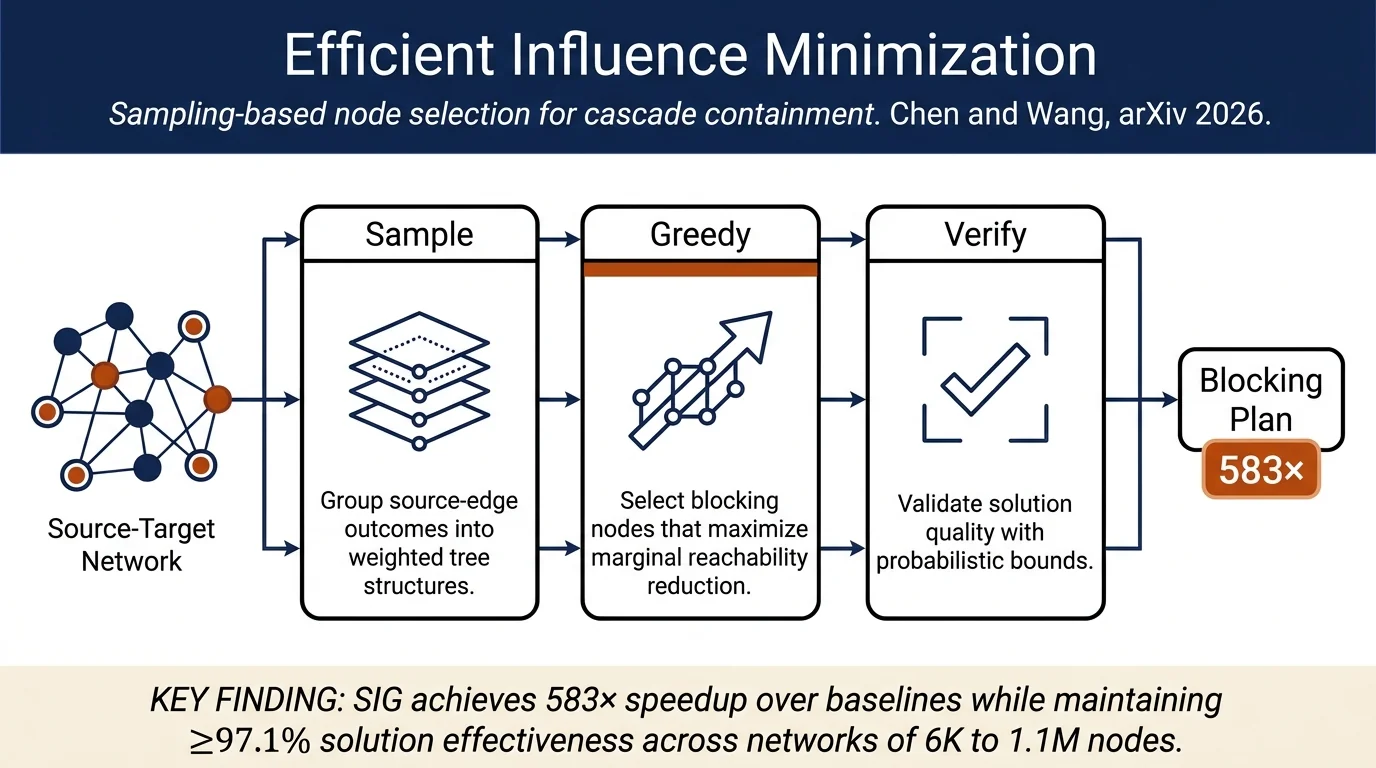
Influence minimization seeks to identify a set of nodes (users, accounts, or information sources) to remove or block from a network such that the spread of harmful information—rumors, misinformation, infectious disease claims—is minimized. It is the inverse of influence maximization (which seeks to maximize spread) and is motivated by content moderation, public health interventions, and limiting the reach of disinformation campaigns.
The problem is typically studied under diffusion models like the Independent Cascade (IC) model or Linear Threshold model, where information spreads stochastically through edges in a social network. Given a source set and a budget k, the goal is to select k nodes to block such that the expected number of nodes reached by the information is minimized.
Key papers
- Efficient Influence Minimization via Source-Integrated Sampling — proposes SIG, a sampling framework achieving 583× speedups while maintaining high solution quality.
Related topics
- Influence maximization (the inverse problem: spreading information widely)
- Cascade Models (probabilistic models of information spread)
- Network intervention (general methods of changing networks to achieve goals)
- Content moderation (practical application to limit harmful content)