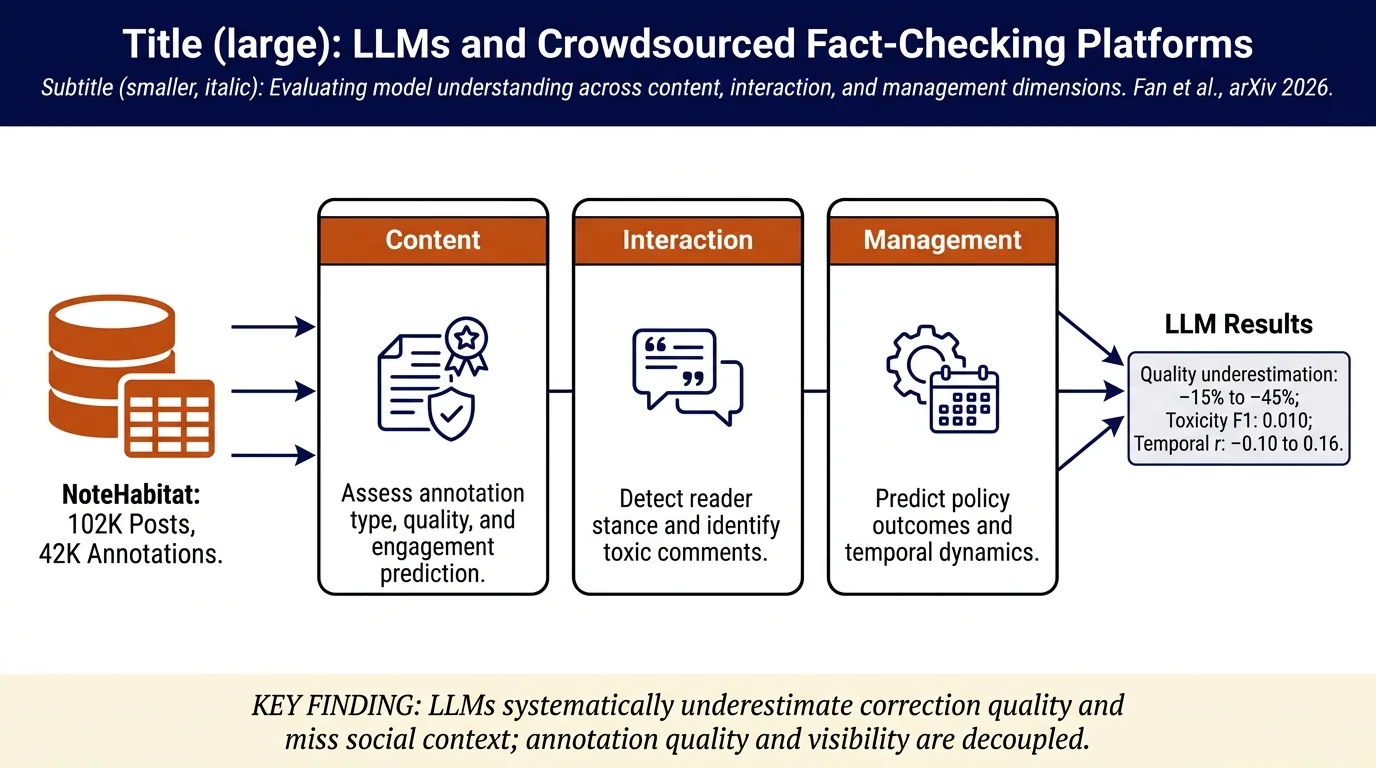
The study of how to measure and evaluate the quality of fact-checking corrections, including dimensions like relevance (does the correction address the claim?), evidence support (is the correction backed by evidence?), objectivity (is the correction free of opinion?), helpfulness (does it help readers understand why the claim is false?), and fluency (is it clearly written?). Research examines whether higher-quality corrections are more effective at changing beliefs, whether they receive more engagement from audiences, and how platform visibility mechanisms shape which corrections survive.
Key concepts
Quality dimensions — Corrections can be assessed on multiple criteria: topical relevance, strength of evidence, logical clarity, absence of opinion, factual accuracy of the correction itself, and comprehensiveness.
Quality vs. engagement paradox — Research finds weak or uncorrelated relationships between correction quality (especially evidence support and objectivity) and audience engagement (likes, shares, visibility). High-quality corrections may go unseen; popular corrections may lack evidence. This creates a market failure in crowdsourced fact-checking.
Systematic assessment challenges — Automated models consistently underestimate correction quality, particularly on dimensions like evidence support. This suggests that quality assessment requires understanding linguistic subtlety, context, and domain expertise that current models lack.
Visibility constraints — Even when corrections are high-quality, platform design, algorithmic ranking, and user behavior can hide them from audiences. Corrections addressing misinformation may never reach the people who saw the false claim.
Key papers
- No Note Is an Island: Probing LLMs' Understanding of Crowdsourced Fact-Checking Environments — demonstrates that annotation quality correlates only weakly with engagement (ρ=0.068), and LLMs systematically underestimate quality on evidence support and objectivity dimensions
Related topics
- Fact-checking and corrections — corrections as output of fact-checking
- Label quality — measuring and improving label reliability
- Crowdsourced annotation — lay annotators assessing correction quality
- Platform dynamics — how visibility mechanisms affect correction reach