 Preslav Nakov
Contributions
- Problem framing: Introduces a realistic evaluation scenario where fake news detectors must identify both human-written and LLM-generated misinformation, exposing a gap in prior work that tested only one type.
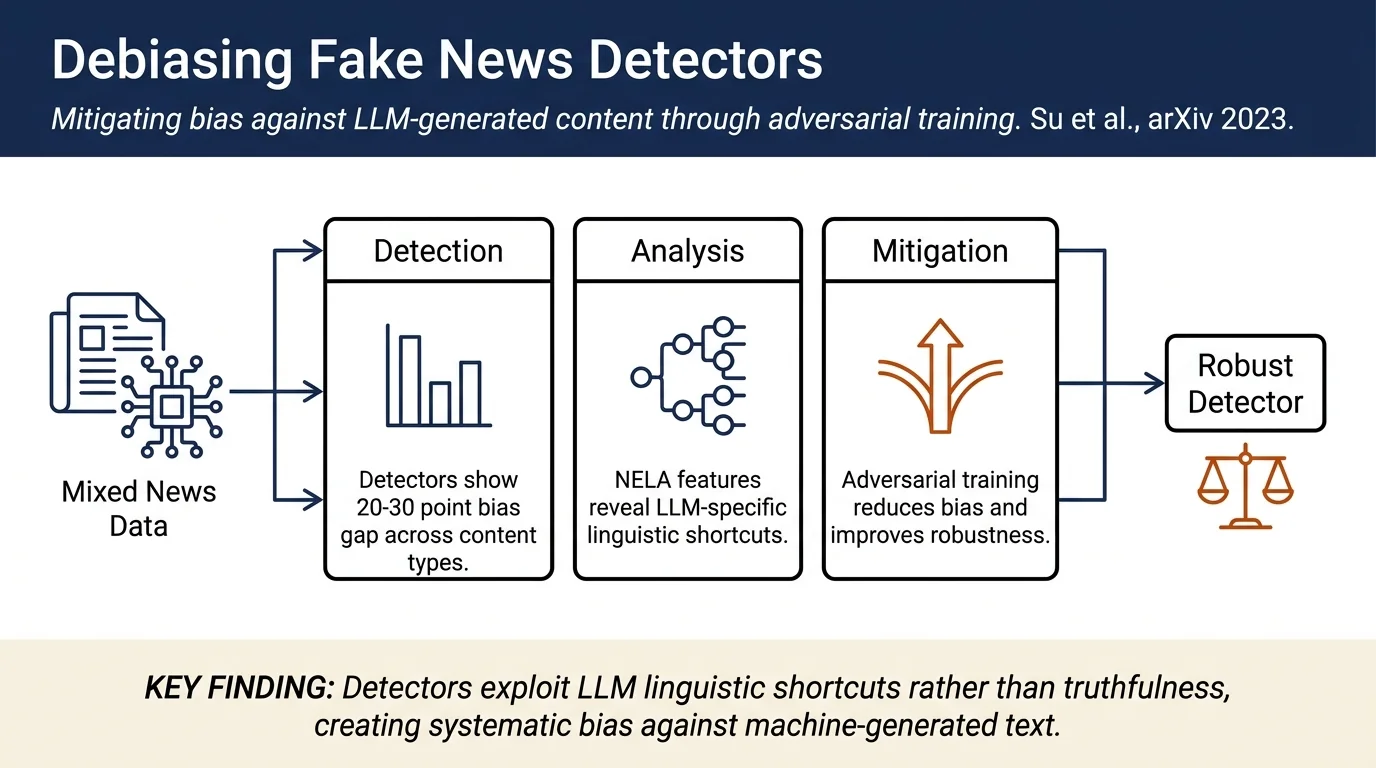
- Bias discovery: Demonstrates that widely-adopted detectors (RoBERTa, BERT, ELECTRA, ALBERT, DeBERTa) disproportionately classify LLM-generated content as fake news, with accuracy gaps exceeding 20–30 percentage points on LLM-generated versus human-written fake content.
- Linguistic analysis: Uses News Landscape (NELA) features to identify that the bias arises from exploitable linguistic "shortcuts" inherent to LLM outputs (style, complexity, bias, affect, morale, event dimensions).
- Mitigation method: Develops a debiasing technique via adversarial training with LLM-paraphrased genuine news, reducing biases and improving detector performance on both human-written and machine-generated content.
- Benchmark datasets: Releases $\texttt{GossiPCop++}$ (97 LLM-generated articles, 4,084 total) and $\texttt{PolitiFact++}$ (4,084 LLM-generated articles) for future research.
Method
Data generation and prompting: The authors use ChatGPT with Structured Mimicry Prompting (SMP), a carefully designed prompt that instructs the model to extract and paraphrase title and article content from human-written news, generating high-quality synthetic fake news aligned with human-written articles.
Fake news detectors: Five pre-trained language models are evaluated in two settings:
- Pre-LLM Era: Detectors trained only on human-written and fake news ($D_{HR}$ and $D_{HF}$)
- LLM Era: Detectors trained on a balanced mix of human-written and LLM-generated fake news ($D_{HR} \cup D_{HF} \cup D_{MF}$)
Bias analysis: Using Tukey's pairwise significance test, the authors compute NELA features across six dimensions (style, complexity, bias, affect, morale, event) and compare disparities between human-written fake, LLM-generated fake, and genuine news. Logistic regression and decision tree models identify which features most strongly distinguish LLM-generated from human-written content.
Debiasing via adversarial training: The model's loss function is modified to jointly train on the combined dataset with a weighting strategy that emphasizes examples where LLM-paraphrased genuine news are misclassified as fake, forcing the detector to learn more robust, content-agnostic features.
Results
RQ1: Detector performance across eras. RoBERTa-Large achieves F1 scores of 87.61 on $\texttt{GossiPCop++}$ and 78.98 on $\texttt{PolitiFact++}$, outperforming most counterparts. However, a discrepancy emerges between human-written fake news detection (88.16% recall on $\texttt{GossiPCop++}$) and LLM-generated fake news (80.33% recall), suggesting inherent bias.
RQ2: Nature of the bias. Most NELA features differ significantly between human-written and LLM-generated fake news. For $\texttt{GossiPCop++}$, the debiased logistic regression model shows a 9.8 percentage point drop in accuracy for LLM-generated fake news (95.79% → 86.51%) but a 6.6 point gain for human-written fake news (47.33% → 53.89%), confirming that standard classifiers exploit LLM-specific linguistic shortcuts rather than truthfulness signals.
Mitigation effectiveness: After debiasing, the accuracy gap between human-written and LLM-generated fake news narrows significantly. The debiasing technique effectively mitigates detection biases while maintaining or improving overall detection accuracy for both content types.
Notes
This work fills a critical gap in fake news detection research by exposing a subtle but pervasive bias that existing detectors inherit from their training data and architecture. The finding that detectors perform better on LLM-generated fake news than human-written ones—contrary to intuition—is striking and implies that LLM-paraphrased content exhibits easily-detected statistical signatures. The linguistic feature analysis grounds the finding empirically and suggests that future detectors trained on mixed human/machine content may inadvertently learn content-modality shortcuts rather than truthfulness signals. The proposed adversarial training mitigation is pragmatic but incremental; deeper architectural innovations may be needed for truly robust detection as LLM capabilities advance. The two new benchmark datasets are valuable, though at current scale (4K–4K articles) they represent a snapshot; ongoing curation as LLM models evolve will be essential.